InsightsA full sovereign credit assessment — quant model, qualitative layer, designed report — in one afternoon
A full sovereign credit assessment — quant model, qualitative layer, designed report — in one afternoon
What happens when the qualitative layer of sovereign analysis becomes scalable, consistent and fully auditable.
Bernhard Obenhuber Sep 14, 2026
Every sovereign credit team knows the coverage asymmetry. The universe is 100+ countries; analyst capacity covers a fraction of it. Quantitative scores scale, but they miss what ratios cannot see — policy credibility, a consolidation path actually being delivered, a banking stress contained rather than building. Traditional qualitative work costs analyst-days per country, so it covers the top exposures and skips the tail — precisely where surprises live.
In August we ran an experiment to close that gap for the Republic of Austria: a full qualitative sovereign assessment — 46 anchored indicators across nine risk sections, plus 40 notching adjustment factors, rated by AI agents strictly from a 534-source evidence corpus — combined deterministically with our quantitative Sovereign Risk Score, and delivered as an 11-page designed credit report with charts and a complete evidence trail. End to end, including validation and the PDF: one afternoon.
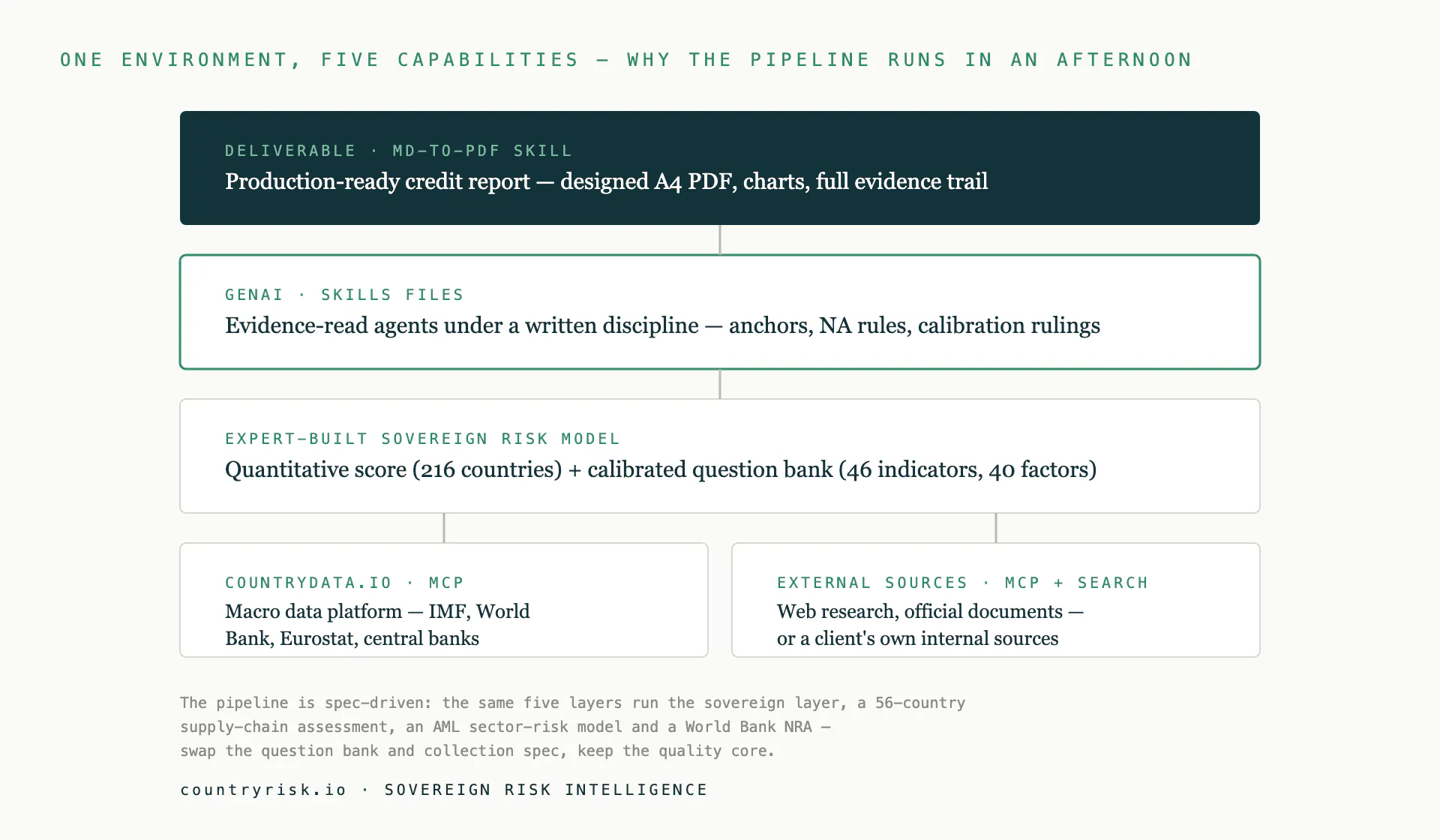
This post is about how, and specifically about why it only works because everything runs in one place. The pipeline itself is generic — we have run the same architecture over a World Bank money-laundering methodology, a 56-country supply-chain assessment and an AML sector-risk model. What made the sovereign instance fast, consistent and auditable is the integrated CountryRisk.io environment it runs in: the data platform, the expert methodology, the AI evidence-readers, the external connectors and the report design system are not five products glued together — they are five layers of one system.
The pipeline in one paragraph
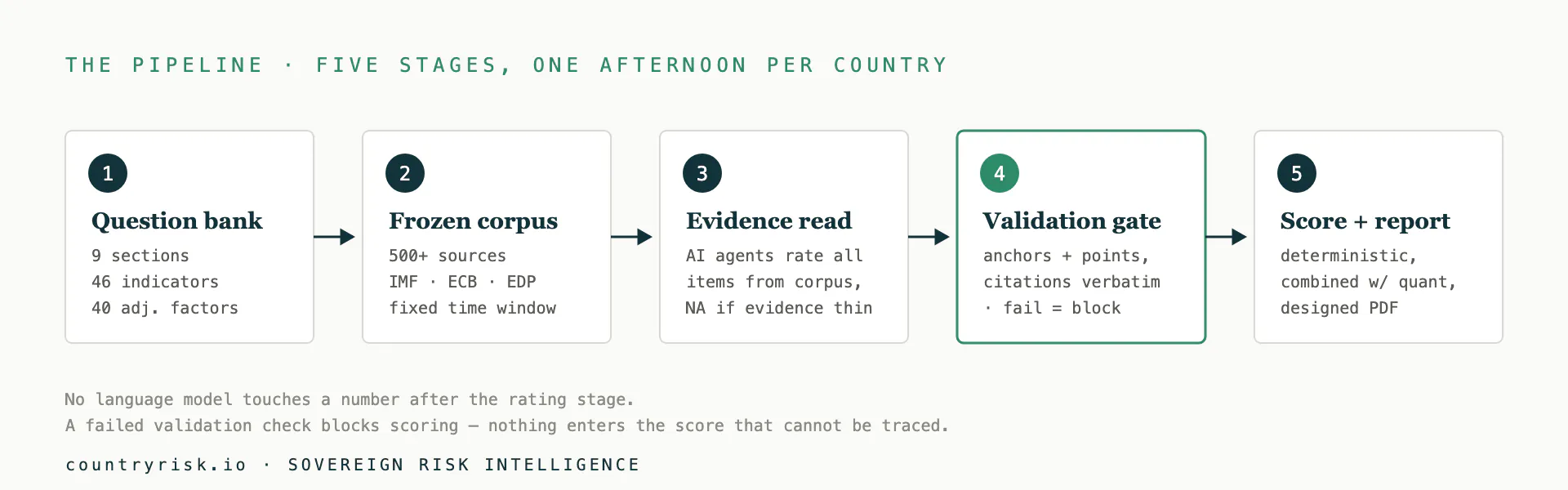
A calibrated question bank turns qualitative judgment into a scored, comparable framework: nine risk sections, 46 indicators with anchored answer options and fixed risk points ("Very supportive → 0 … Very impedimental → 20"), 40 adjustment factors for notching. Collection agents build a frozen corpus per sovereign for a defined time window — for Austria, 534 sources: IMF Article IV, ECB and OeNB material, EU excessive-deficit-procedure documents, the statistical office, the fiscal council, quality press. Evidence-read agents then rate every item strictly from that corpus under a written evidence discipline: no defaulting to the middle option, media volume is not evidence, documented strength counts as much as documented harm, and "insufficient evidence" is an explicit NA that drops out of both numerator and denominator — never a guess. A machine validation gate checks exact anchor labels, correct point values, completeness, and verifies every cited source verbatim against the corpus; a failed check blocks scoring. Only then does a deterministic scorer add the qualitative points into the quant model's risk sections and map the result to the 20-notch rating scale (excluding the default-category). No language model touches a number after the rating stage.
Why the integrated environment is the story
Any of these stages could, in principle, be built standalone. What we learned is that the compounding value comes from running them inside one environment — the same one our clients already use.
CountryData.io as the data backbone. The quantitative model's inputs — five-year averages of growth, fiscal balance, debt, external position, governance, across 216 countries — come straight from our CountryData.io platform, which harmonizes IMF WEO, World Bank WDI/WGI, Eurostat and central-bank sources. Crucially, the platform is exposed to the AI agents over MCP: an evidence-reader that needs to check whether Austria's current-account surplus is persistent or a one-off doesn't paraphrase a press article — it queries the same curated series the quant model was scored on. Quant and qual are literally reading from the same numbers.
An expert-built sovereign risk model — both halves of it. The quantitative Sovereign Risk Score is a methodology our analysts have built and maintained for years; version 2 covers 216 countries across four risk sections. The qualitative question bank is expert work of the same kind: the anchors, point values and section structure encode what a senior sovereign analyst actually looks for, and a mapping file ties each qualitative section to the quant section it informs. The combination is deterministic — points addition per section, methodology weights, 20-notch mapping — so the qualitative layer contributes a defined 15–25% of the combined mass by construction. AI executes the methodology; it does not invent one.
GenAI governed by skills files. The agents don't run on vibes. The assessment guide — evidence rules, output schema, and a growing list of versioned calibration rulings ("pre-1945 moratoria are out of scope"; "an EU excessive deficit procedure counts as a demanding external programme") — is a skill file the agents load and are bound by. When a human reviewer disagrees with a call, the resolution becomes a new ruling in the skill, and every subsequent country inherits it. That is the calibration loop: analyst judgment moves to the top of the process — setting anchors, writing rulings, reviewing flagged calls — and out of the research grind.
MCP integrations for everything outside our walls. Evidence collection needs the open world: IMF and Commission documents, national sources, press. The collection spec declares which tools the agents may use and how sources are tiered — official/IFI first, rating-agency material labeled and restricted, and an "independent mode" that excludes rating-agency judgments entirely so the result can be compared against the agencies rather than derived from them. Because the tool layer is MCP, it is pluggable: a client can wire in its own connectors — an internal research repository, a proprietary data service — and the agents read those under the same discipline, with the same audit trail showing exactly what was read.
md-to-pdf for a report you can hand to a committee. The pipeline's raw output is a markdown report with the full item-level evidence trail. Our md-to-pdf skill turns it into a production-ready document in the CountryRisk.io design system — hand-paginated A4, score-history and section charts, a ratings-summary table, a source appendix with tier shares. The Austria report runs 11 pages and is generated mechanically, which means a refresh is genuinely a refresh: re-run the country when its window moves or an event hits, and corpus, assessment and report all regenerate.
What came out for Austria
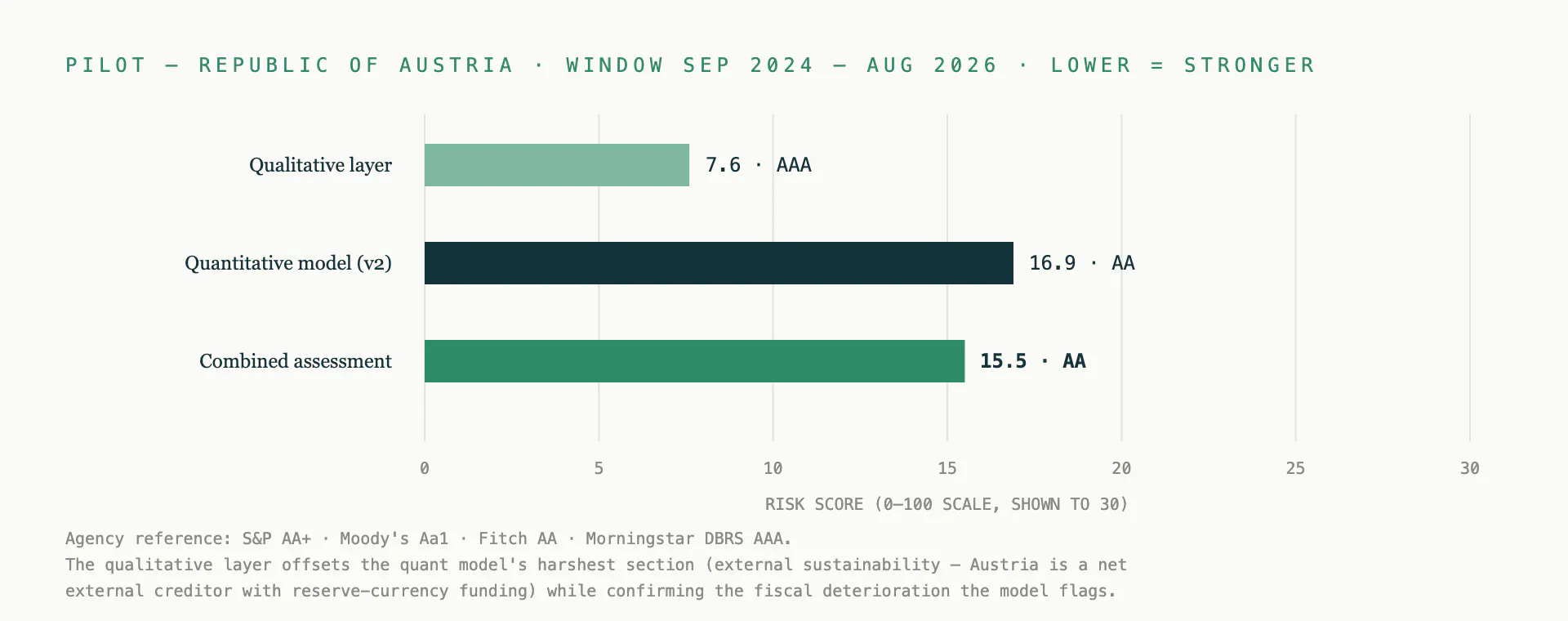
The quantitative model places Austria at 16.9 — AA. The qualitative evidence pass comes in stronger, at 7.6 — AAA, and the combined assessment lands at 15.5 — AA, alongside agency ratings of AA+ (S&P), Aa1 (Moody's), AA (Fitch) and AAA (DBRS).
The interesting part is where the two layers disagree. The quant model's harshest section is external sustainability — a ratio-driven verdict. The qualitative layer, reading the actual record, offset it: Austria is a net external creditor with a positive net international investment position of roughly 22–26% of GDP, funding itself in the world's second reserve currency with 8.9x average syndication oversubscription. Ratios understated a structural strength, and the evidence pass caught it.
In the other direction, the qualitative layer independently confirmed what the model flags: the fiscal deterioration is real. The window covered the longest recession since 1945, a 2024 deficit of 4.7% of GDP against a budgeted 2.9%, and the opening of an EU excessive deficit procedure — against which a new three-party government legislated consolidation packages that are so far meeting their targets. The report's credit view says it plainly: capacity to pay is beyond doubt; the question is whether fiscal discipline holds across a fragile coalition. That is a sentence a ratio cannot write and an analyst would need weeks to source — here it comes with citations, machine-verified against the corpus.
The assessment even withheld a customary benefit: with an EDP open and agency outlooks negative, the qualitative layer declined to award the usual notch for sovereign banking-support capacity, on the documented ground that extraordinary bank support could no longer be extended without fiscal consequence. That is the kind of call anchored evidence-reading makes visible — and reviewable.
Why you should — and shouldn't — trust it
The design conviction behind all of this: an AI-read assessment is worth something only if it is auditable rather than plausible. Every rating is anchored to a written option with fixed points, not an adjective. Every rating is corpus-bound, with two to five cited sources verified verbatim by the validation gate — for Austria, 100% of citations machine-checked. Validation blocks scoring rather than commenting on it afterwards. And low-confidence items and every adjustment-factor notch are flagged into a human review queue, because the reviewer's job is to check anchored, cited judgments — not to write country research from scratch.
What a lean team gains
For a credit risk team of five or seven covering a hundred-plus sovereigns, the arithmetic changes. Coverage: a full qualitative assessment in hours, not analyst-weeks — the tail of the portfolio stops being unassessed. Consistency: the same anchors and evidence rules applied to Austria and to Zambia, with no drift between analysts or vintages. Auditability: a complete evidence trail per rating — corpus, citation, rationale, confidence, validation log — ready for model governance and regulators. And refresh on demand: when the window moves or an event hits, the assessment regenerates mechanically while the analyst's scarce judgment stays where it belongs — on the anchors, the rulings and the flagged calls.
This is the capability we are building into the CountryRisk.io platform as a product feature. If you run a sovereign universe on a question bank of your own — internal, supervisory or commercial — it is exactly the kind of methodology the pipeline was designed to onboard.
The Austria credit report (11 pages: combined ratings summary, score history, section-by-section analysis with quant and qualitative detail, and the full source appendix) is available on request.