InsightsCloser to the Source: How Technology Changes Country Research
Closer to the Source: How Technology Changes Country Research
Technology brings country research closer to primary sources, redefining the role of research providers.
Bernhard Obenhuber Aug 19, 2026
For a long time, secondary research providers occupied a privileged position between countries and decision-makers. They collected statistics, read official reports, followed political developments, spoke to people on the ground and turned this material into a country view. Their value came partly from judgment—but also from the difficulty of finding, organizing and comparing the underlying information.
Technology is changing that division of labor.
It is not simply making the traditional research process faster. It allows analysts to work much closer to the primary information source: a statistical release rather than a chart copied into a report; the text and impact assessment of a bill rather than a summary of it; a committee event rather than a retrospective news article; and the statements of government, opposition, journalists and interest groups rather than a single synthesized account of “the political mood.”
This does not eliminate the need for secondary research. It changes what a good secondary research provider must do.
From a living country file to a living country process
In Per-Country AI Skills as the Analyst’s Living Country File, we argued that an AI skill can make an analyst’s country knowledge explicit and reusable. The important asset is not an encyclopedia of public facts. It is the analyst’s current view, source hierarchy, data judgment, scenarios, signposts and understanding of what would change the view.
In Taking Clues from Legal, we compared country research with the legal value chain. Legal technology shows what happens when primary material becomes machine-accessible and interpretation can be regenerated as the source base changes. The middle of the value chain—manual collection, periodic summarization and standardized commentary—comes under pressure.
The next step is to combine these ideas. A living country file should not only preserve what an analyst knows. It should observe the process by which new country information is created.
For Austria, we have started to assemble such a system around several primary-source layers:
official statistics and institutional publications;
parliamentary bills, documents, procedural events, votes and consultation submissions;
verified communication channels of members of parliament, ministers and public institutions;
statements by opposition parties, social partners, other interest groups and experts; and
political journalism, which supplies context, scrutiny and competing interpretations.
The scale of monitoring
Even for a relatively small country, staying close to the primary source is a monitoring problem at considerable scale. As of 19 August 2026, our Austria registry contains 215 named people: all 183 members of the National Council, 16 political journalists and 16 additional stakeholders and public figures. It also contains 43 institutional entities, including ministries, constitutional bodies, regulators, statistical institutions, central-bank and fiscal authorities, political parties and other official organizations. In total, that creates 258 people and entity records whose roles, affiliations and source links need to remain current.
Those records currently contain 305 distinct communication and publication endpoints, of which 301 are marked active. They include 61 active X accounts, 51 Bluesky accounts, 49 Facebook pages, 40 Instagram accounts, 22 official press-release pages, 19 institutional websites, 14 news feeds and 13 LinkedIn accounts. The registry could also cover other social media channels or publication pages. Statistical data is already ingested through a own CountryData.io data management platform and MCP delivery.
The objective is not to collect every post from every platform indiscriminately. It is to build a monitored source universe that reflects the country’s decision-making system and its competing narratives. That means covering the government and governing parties, but also the opposition, parliamentary committees, independent institutions, journalists, social partners and other stakeholders capable of shaping, contesting or implementing policy. It also means recording gaps: a missing or unverified account is itself a coverage issue to resolve, rather than a reason to assume that the stakeholder is silent.
The figures are a snapshot rather than a finished inventory. The current pilot does not yet track the members of the Bundesrat or systematically cover Austria’s provincial political leadership—the governors and relevant decision-makers of Upper Austria, Lower Austria, Vienna and the other federal states. These are important future additions, particularly for policies whose implementation, financing or political negotiation involves the Länder. Officeholders change, institutions are reorganized, accounts move between platforms and new stakeholders become relevant as the policy agenda evolves. Maintaining and expanding the registry is therefore part of the research process, not a one-off data-collection exercise.
The result is not a bigger news feed. It is a source graph: people and institutions are linked to their official roles and communication channels; bills are linked to explanatory memoranda, impact assessments, committees, decision-makers and stakeholder submissions; and every observation retains its date, provenance and source URL.
That distinction matters. A statistical value, a government forecast, an opposition claim and a journalist’s interpretation may all be relevant, but they are not the same kind of evidence. Technology makes it possible to preserve those differences instead of flattening everything into one narrative.
An example: reading Austria’s legislative pipeline through a sovereign-rating lens
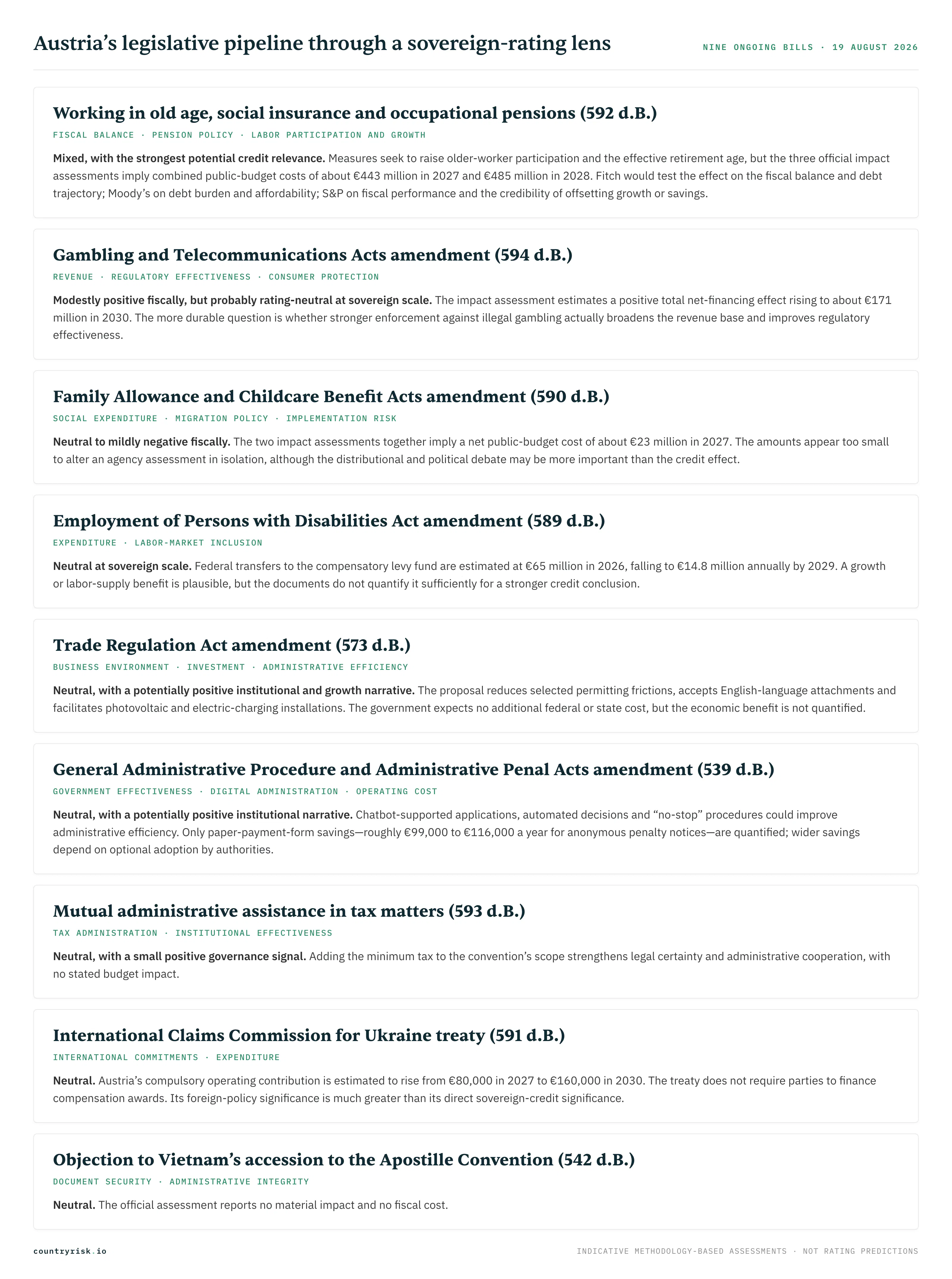
To test what this proximity to primary sources makes possible, we applied a sovereign-rating policy-impact skill to the nine Austrian government bills or treaties that our parliamentary tracker classified as ongoing on 19 August 2026. The skill maps a proposal separately to the Fitch, Moody’s and S&P sovereign methodologies. Certainly, we could also apply different perspectives through bespoke skills (e.g. geopolitical or social cohesion perspective).
The exercise is indicative, not a prediction of any rating action. Rating committees may reach different conclusions, and the exercise lacks a full Austrian rating baseline and updated general-government forecasts. That is precisely why the first analytical task is triage: identify the transmission channel, quantify it where the official impact assessment permits, and reject false precision where it does not.
Across the agencies, the logic is similar but not identical. Fitch’s public-finance analysis emphasizes the fiscal balance, gross government debt, interest-to-revenue burden and the credibility of the debt trajectory. Moody’s looks at fiscal strength through debt burden and affordability, while institutional effectiveness can influence the broader scorecard. S&P combines fiscal performance and debt burden with separate institutional and economic assessments. This is why the same reform can be fiscally negative in the near term, economically positive over time and still too small to affect a rating.
The missing information is also informative. To move from screening to a robust rating-impact assessment, an analyst would need the measures’ treatment in general-government accounts; revised deficit, debt and interest-to-revenue projections; evidence that labor-supply or compliance gains are additional rather than assumed; implementation milestones; and an assessment of whether the costs are permanent, capped or offset elsewhere.
The key conclusion is not that nine bills produce nine rating calls. It is that a systematic process can tell us quickly that one package deserves deeper fiscal work, several measures matter mainly to institutional or growth narratives, and others have no plausible sovereign-rating consequence at their stated scale. Avoiding manufactured significance is itself analytical value. The same process also lets us monitor whether potentially important measures are watered down during negotiations, stalled in committee or shelved altogether. That distinction is essential: the credit impact of an announced policy depends not only on its original design, but also on whether it survives the political process and is ultimately implemented.
Views are primary information too
Official documents explain what a government proposes and, through impact assessments, what it expects to happen. They do not fully explain whether implementation is politically feasible, which groups bear the cost, how the opposition will frame the measure or where practical problems may emerge.
That is why the communication layer matters.
Government communication helps identify the intended narrative and political ownership. Opposition communication reveals contested assumptions, alternative priorities and potential implementation resistance. Social partners and specialist groups often expose operational consequences before they appear in aggregate data. Journalists test claims, uncover inconsistencies and show which issues are gaining salience. Direct communication on X, Bluesky and official press pages can provide early signals from all of these groups.
But proximity does not mean uncritical acceptance. A social-media post is a primary source for what a person chose to say—not proof that the claim is true. An official impact assessment is authoritative evidence of the government’s estimate—not a guarantee that the estimate will materialize. A consultation submission documents a stakeholder position—not evidence that the stakeholder caused a later amendment.
A useful research system therefore keeps three questions separate:
What happened or was formally proposed?
Who says what about it?
What does the available evidence imply for the analytical question?
AI can help connect these layers, detect changes and compare claims with documents. The separation between fact, forecast, position and interpretation remains an analytical responsibility.
The new role of the secondary research provider
If access and summarization become cheaper, the secondary research provider cannot remain primarily a distributor of condensed public information. Its defensible value moves to five areas.
Second, quality control: detecting missing coverage, stale accounts, revised statistics, duplicated claims and conflicts between sources. Research providers must also develop analytical tools that identify systematic biases in sources, datasets, models and the research process itself, and make those biases visible to the analyst rather than silently reproducing them.
Third, explicit analytical methods: encoding sovereign-rating frameworks, debt-sustainability models, policy transmission channels, different geopolitical reasoning frameworks and country-specific playbooks so that analysis is repeatable and open to challenge.
Fourth, context and comparison: knowing whether €500 million is large for the sovereign, whether a procedural event is routine, whether a stakeholder is representative and how the same policy would transmit differently across countries.
Fifth, judgment and accountability: deciding what matters, stating uncertainty, resisting false significance and taking responsibility for the conclusion.
This is a demanding transformation. Working closer to primary information produces more evidence, but also more noise, competing narratives and opportunities for error. It makes verification and source governance more important, not less. It also raises the bar for research providers: if the client can reach the underlying document, every analytical claim should be traceable and every layer of interpretation should add something observable.
The future of secondary research is therefore not simply faster report writing. It is a move from being an information intermediary to operating an evidence and reasoning system—one that follows how a country makes decisions, listens to the people contesting those decisions, connects policy to measurable outcomes and preserves the analyst’s judgment about what it all means.
The closer we can get to the source, the clearer the value of genuine analysis becomes.
Reach out if you would like to get a PDF of the assessment report: [email protected]