InsightsHow Governance Assessments Shape a Country’s Access to Finance
How Governance Assessments Shape a Country’s Access to Finance
Governance assessments shape how rating agencies, lenders, investors and banks view a country—and governments need to understand the evidence behind them.
Bernhard Obenhuber Sep 21, 2026
A finance ministry can explain its debt trajectory, defend its fiscal assumptions and present a credible growth forecast. Somewhere else, an expert assessment is recording a view of the country's regulatory quality, political stability or government effectiveness. A survey is capturing businesses' and people's experience of public administration. Those judgments can enter a governance indicator, and that indicator can enter the sovereign credit assessment the ministry is preparing to discuss.
This is easy to miss because the responsibilities sit in different places. The debt office prepares the fiscal numbers. Justice institutions hold evidence about court performance. Sector regulators know whether implementation has improved. The statistical office publishes the data. Yet the external assessment brings those fragments together into a view of the country. A government needs to understand how that view is assembled, which evidence supports it and who is responsible for keeping that evidence current. In many instances, there is no gatekeeper within the government or administration that systematically monitors relevant external assessments and engages with these external providers in a constructive way.
Our analysis puts numbers around the importance of that task. Across 147 economies and three decades of annual observations, institutional factors are among the key explanatory factors associated with sovereign ratings. For some countries, it is the largest component of the measured risk mix. For others, institutional strength helps explain why their ratings are stronger than economic indicators alone would suggest.
Institutions already sit inside the assessment
The World Bank's Worldwide Governance Indicators, or WGI, are widely used proxies for measuring institutional quality. They summarize six dimensions of governance, including government effectiveness, regulatory quality, rule of law and control of corruption. Their influence extends through their use by other assessors. World Bank WGI overview.
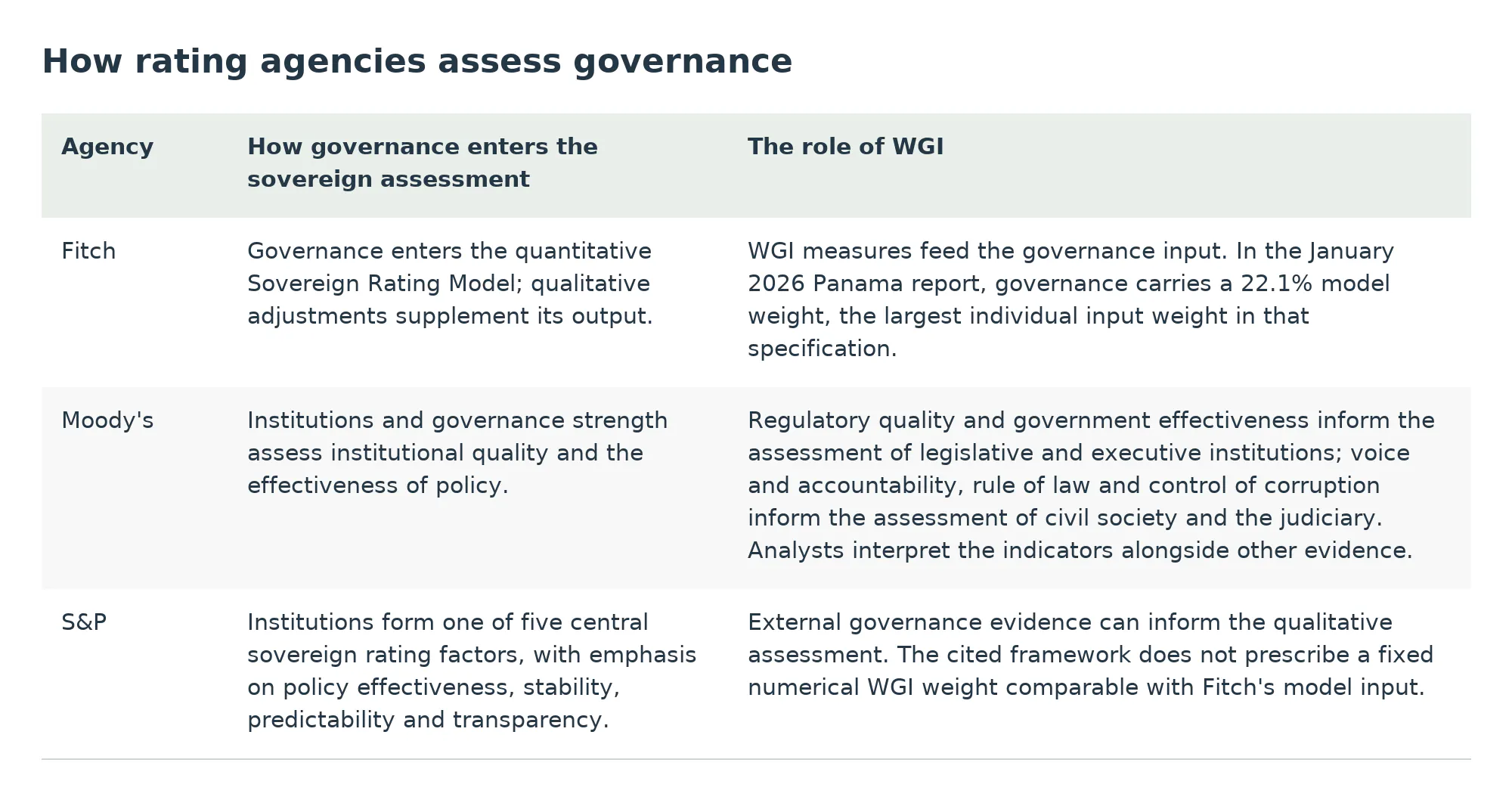
The three agencies incorporate this evidence in similar ways:
That changes the practical question for a government preparing its credit story. Alongside the accuracy of the fiscal forecast sits another question: what evidence about the country's institutions has already entered the assessment?
The same governance assessment travels beyond the rating
The sovereign rating is one destination for institutional assessments. The same evidence also enters decisions about export-credit terms, financial-crime controls and investment risk. This makes governance relevant to several parts of a country's external financial relationships at once.
OECD country-risk classifications connect institutions to export-credit pricing. The Country Risk Assessment Model used by Participants to the Arrangement on Officially Supported Export Credits includes four groups of indicators: payment experience, the financial situation, the economic situation and the institutional situation. The institutional group very likely draws on World Bank governance indicators; although the exact model specification is not public. Expert judgment supplements the model, and the resulting classifications help determine minimum credit-risk premium rates under the Arrangement. Institutional assessments therefore enter a framework with a direct financing application. These are purpose-specific risk classifications, with coverage exceptions, rather than a general ranking of national performance. OECD country-risk classification methodology.
Banks' AML country-risk assessments connect governance to scrutiny of customers and transactions. Corruption, weak institutions and shortcomings in enforcement matter when a bank assesses the financial-crime environment of a jurisdiction. The Wolfsberg Group's guidance identifies political stability and governance, including assessments against World Bank standards, among the relevant structural factors. Country-risk assessments then inform customer due diligence, transaction monitoring and risk appetite. A governance weakness can thus be relevant to the documentation and scrutiny faced by a country's businesses and residents. The outcome depends on the bank's methodology and the wider customer and transaction risk profile; a WGI score does not mechanically trigger a particular control. Wolfsberg Group, Country Risk FAQs.
Investors' in-house models connect governance to country comparisons and fair-value spreads. Asset managers compare sovereign fundamentals across countries to assess whether emerging-market bond spreads adequately compensate for risk. Governance can enter alongside growth, debt, fiscal and external indicators, helping distinguish countries with similar macroeconomic numbers but different institutional strengths. GMO, for example, describes a regression-based process that combines economic and ESG information to estimate fair-value sovereign spreads and compares those estimates with market spreads. The result helps identify bonds that appear expensive or cheap relative to fundamentals. GMO, Sovereign ESG Integration.
WGI provides a common source of institutional measures for these country assessments. EFG Asset Management is one published example: its July 2021 sovereign ESG methodology uses all six WGI dimensions to supplement sovereign risk analysis. The precise use and weight vary across managers; an institutional score may inform a fundamental comparison, an ESG assessment or a valuation input rather than translate directly into a spread. EFG Asset Management, Sovereign Rating Methodology, p. 9.
The implication is that one institutional weakness—or one gap in the evidence about it—can be relevant to several external assessments. These are not independent confirmations when they draw on common sources. For government, tracing those shared inputs can help coordinate work across the debt office, trade authorities, financial supervisors and the institutions responsible for reform.
The relationship is visible in the data
We use the four pillars of the CountryRisk.io sovereign risk score: growth and monetary stability, institutions, public finances, and external debt sustainability. Each measures risk on a 0–100 scale, with higher values indicating greater risk. We compare them with the rounded average of the available DBRS, Fitch, Moody's and S&P ratings.
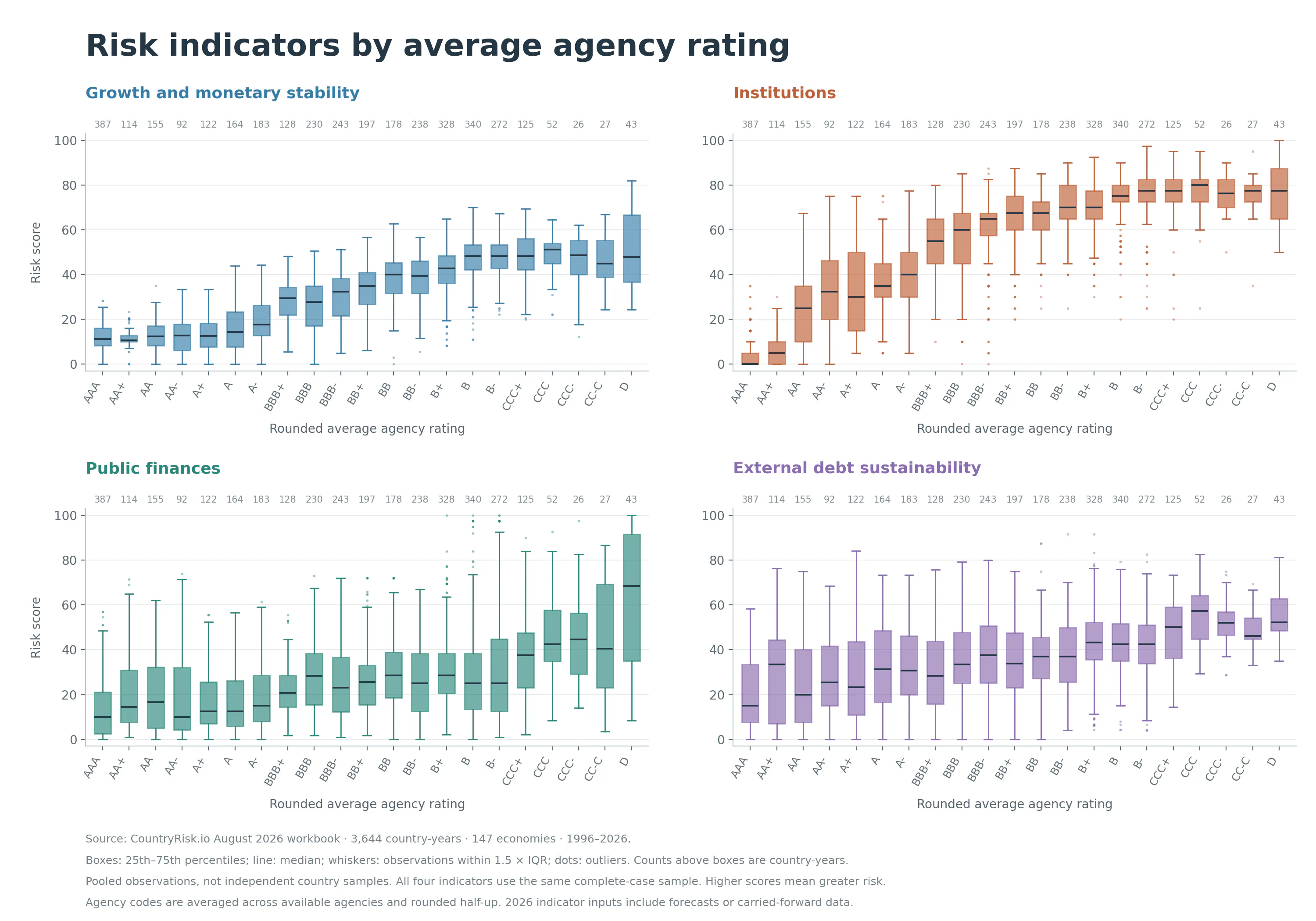
The first picture is descriptive. When country-year observations are grouped by agency rating, the institutional distributions move markedly. Median institutional risk is 0 among AAA observations, 60 among BBB observations, and 75 among B observations. The distributions overlap, but the direction is clear.
1996–2026; 3,644 country-year observations. Boxes show the middle 50% of scores, with a line at the median. Higher scores mean greater risk. Counts above the boxes are country-years, not independent countries.
To test whether institutions add information beyond economic conditions, we estimate two ordered-logit models. One uses all four pillars; the other uses only growth, public finances and external debt. Both use the same 3,644 observations from 147 economies, with no country or year effects.
Including institutions reduces the average in-sample error from 2.36 to 1.64 rating-code points, a reduction of 30.4%. That is evidence of a substantial association after accounting for the other three pillars. It is also consistent with the methodologies: the agencies themselves assess institutions, sometimes drawing on related information.
The countries where the economic story is incomplete
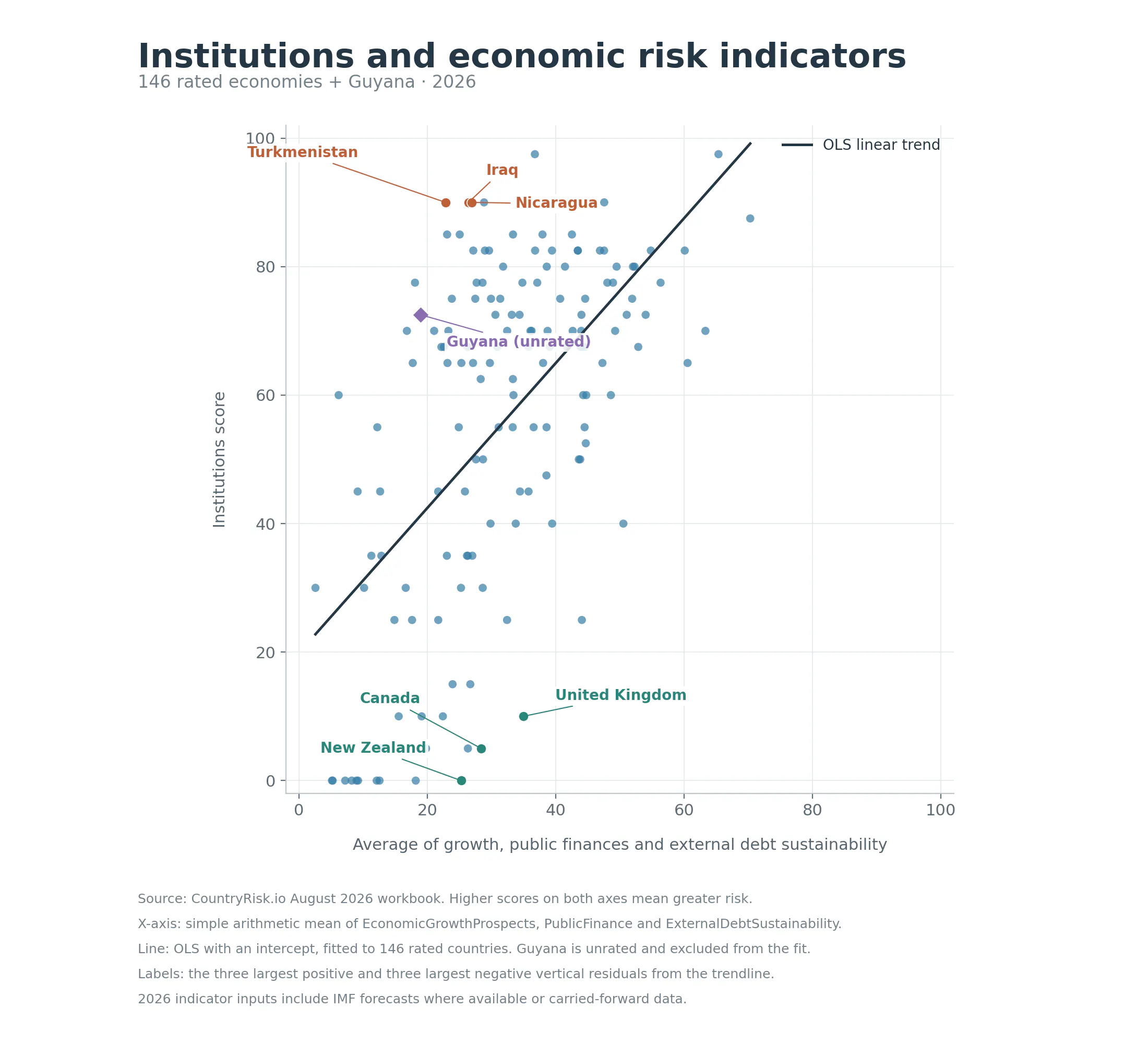
The next chart places the average of the three economic pillars on the horizontal axis and the institutional score on the vertical axis. It asks a simple question: how does the institutional assessment compare with the economic risk profile?
Turkmenistan, Iraq and Nicaragua sit furthest above the line: their institutional risk is high relative to their economic average. The United Kingdom, New Zealand and Canada sit furthest below it. Institutions can therefore be a source of resilience as well as a source of weakness in the measured country profile.
Guyana also stands out. Its institutional risk score of 72.5 sits well above its economic-pillar average of 19.0. Its profile illustrates how a strong economic assessment can coexist with substantially higher measured institutional risk.
Where governance dominates the measured risk mix
There is a second way to prioritize the investigation: estimate how much each pillar contributes to a simple baseline rating model.
For this purpose, we use a separate linear regression, fitted to the same historical sample, with predictions bounded to the rating scale after estimation. Multiplying each pillar score by its coefficient gives four additive contributions. Governance's share is its contribution divided by their total. This provides an explicit accounting reference; it is not a percentage of an actual letter rating explained.
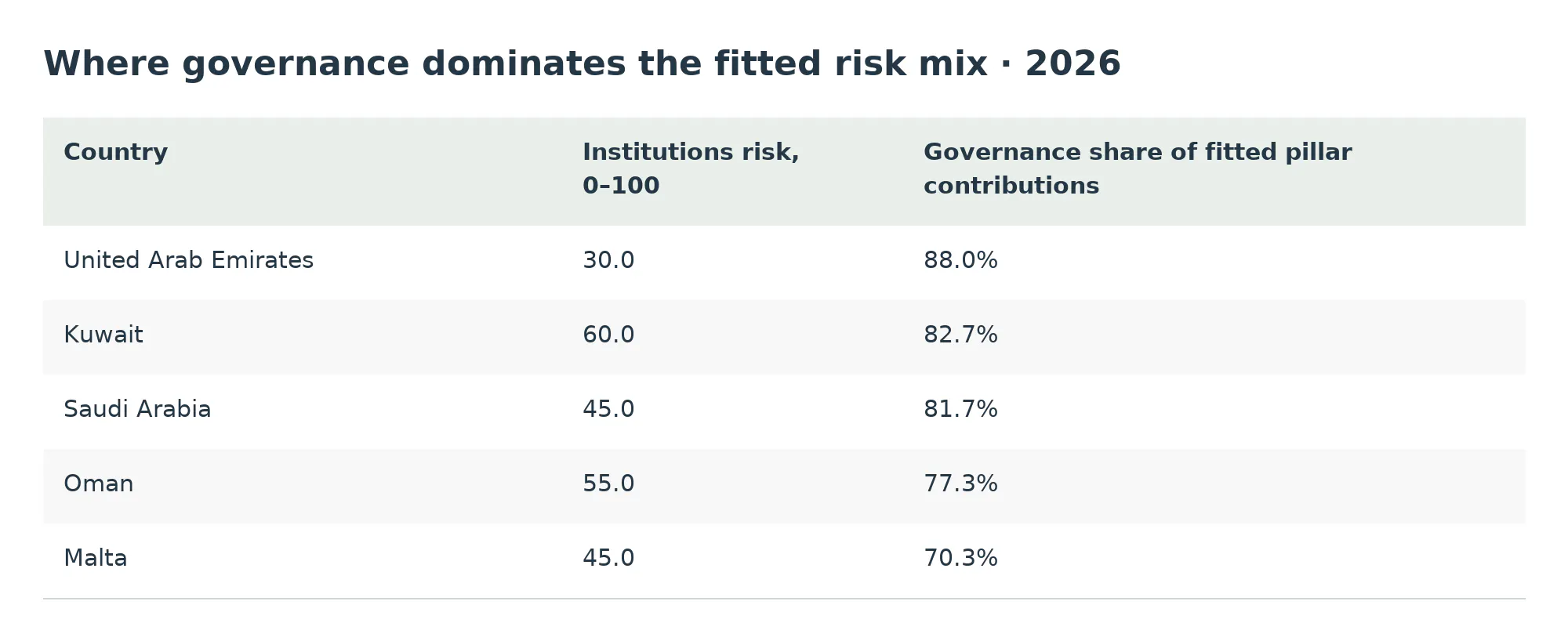
Applied to the 2026 scores, the largest governance shares among rated economies are:
Pooled OLS coefficients applied to 2026 inputs. Shares use zero in every pillar as the reference and exclude the intercept and subsequent clipping adjustment.
The United Arab Emirates shows why this ranking needs interpretation. Its institutional risk score is 30, substantially below many other countries. Governance dominates its fitted risk mix because its other pillars contribute comparatively little risk. A large share identifies the relative importance of an issue within a country's profile; the absolute score helps establish the scale of the weakness.
Across the 146 rated economies, institutions account for 52.9% of summed fitted pillar contributions. Across all 185 scored economies, including those without an agency rating, the figure is 52.8%. These totals give each country's contribution equal treatment, without GDP or debt weighting.
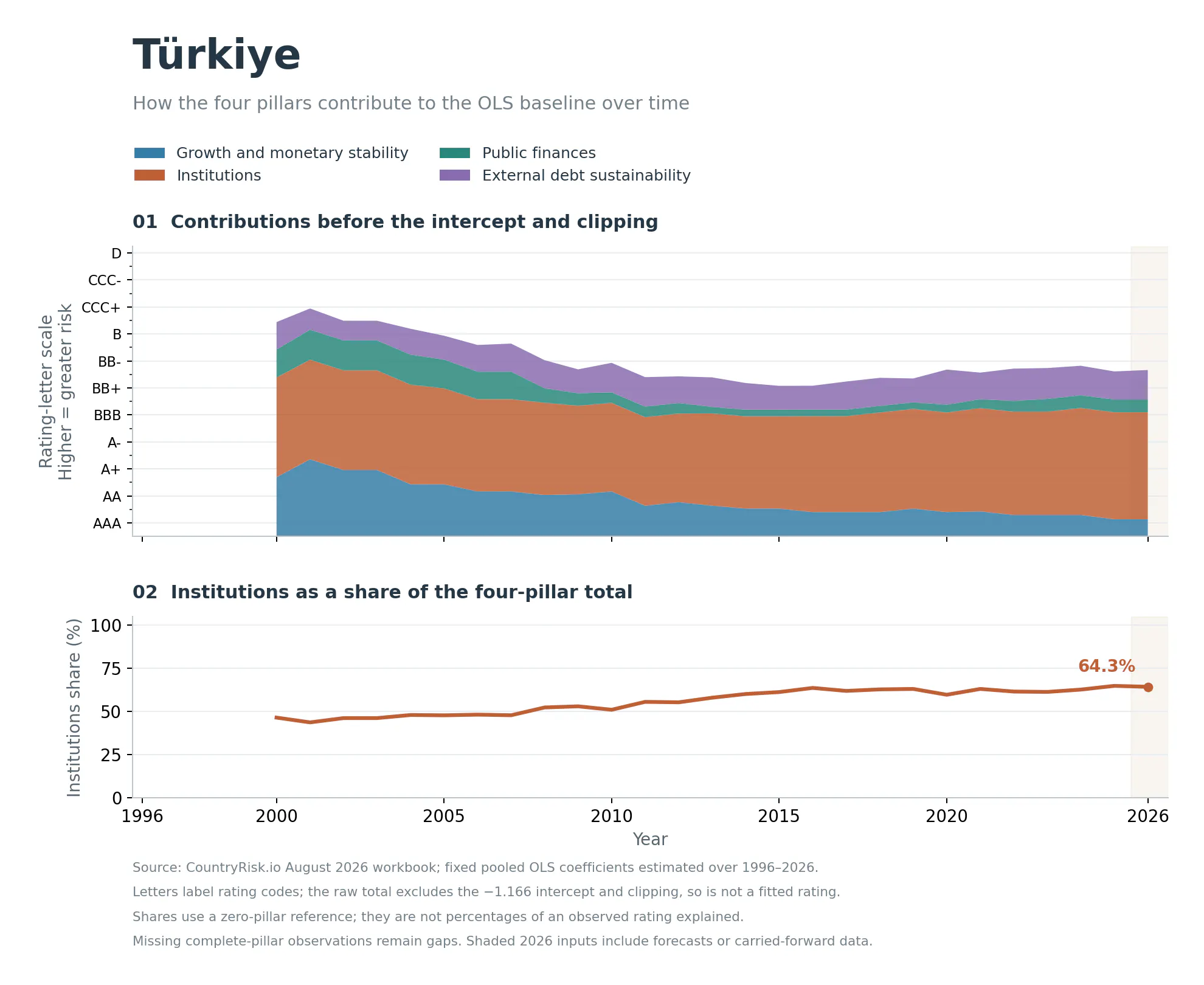
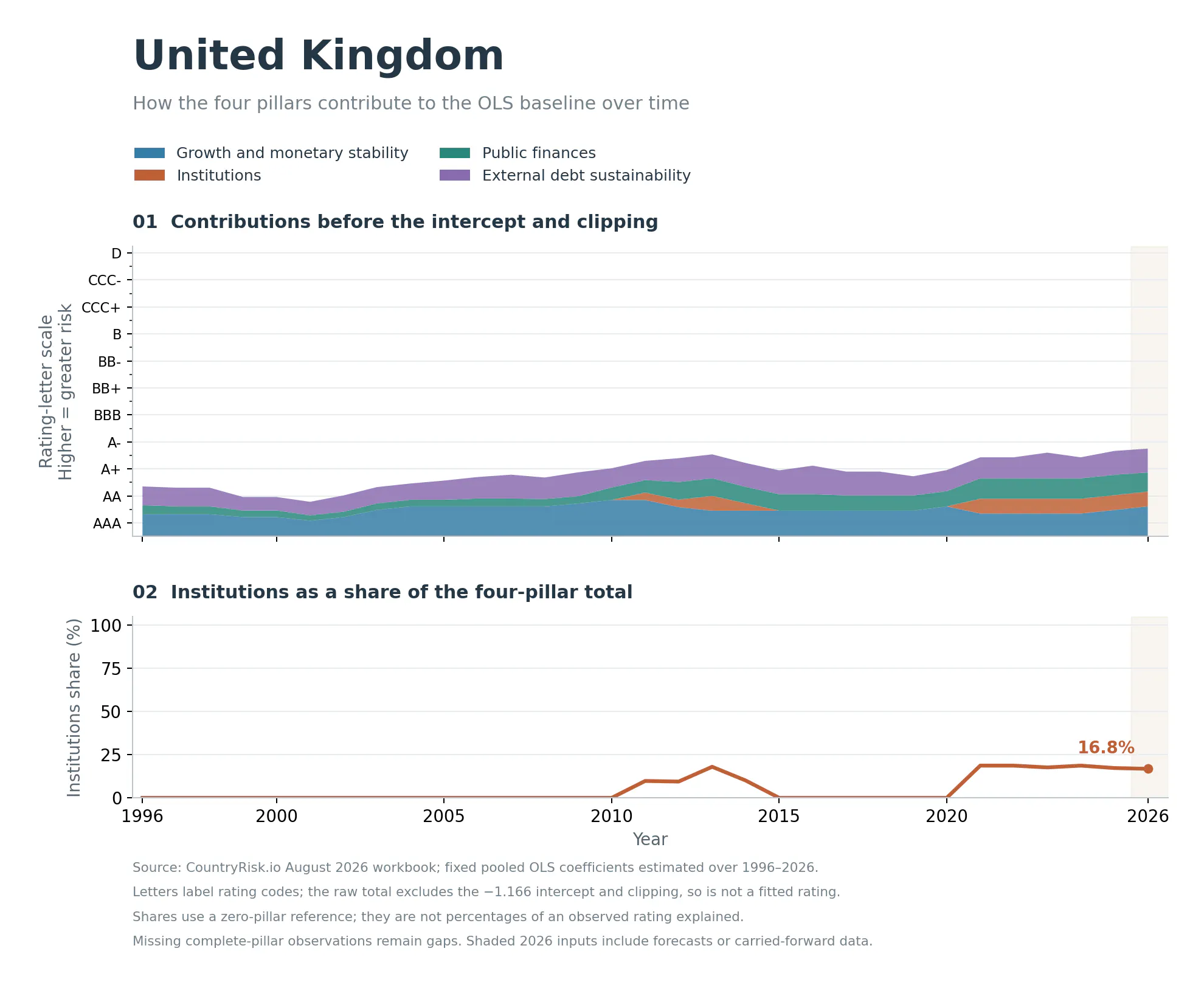
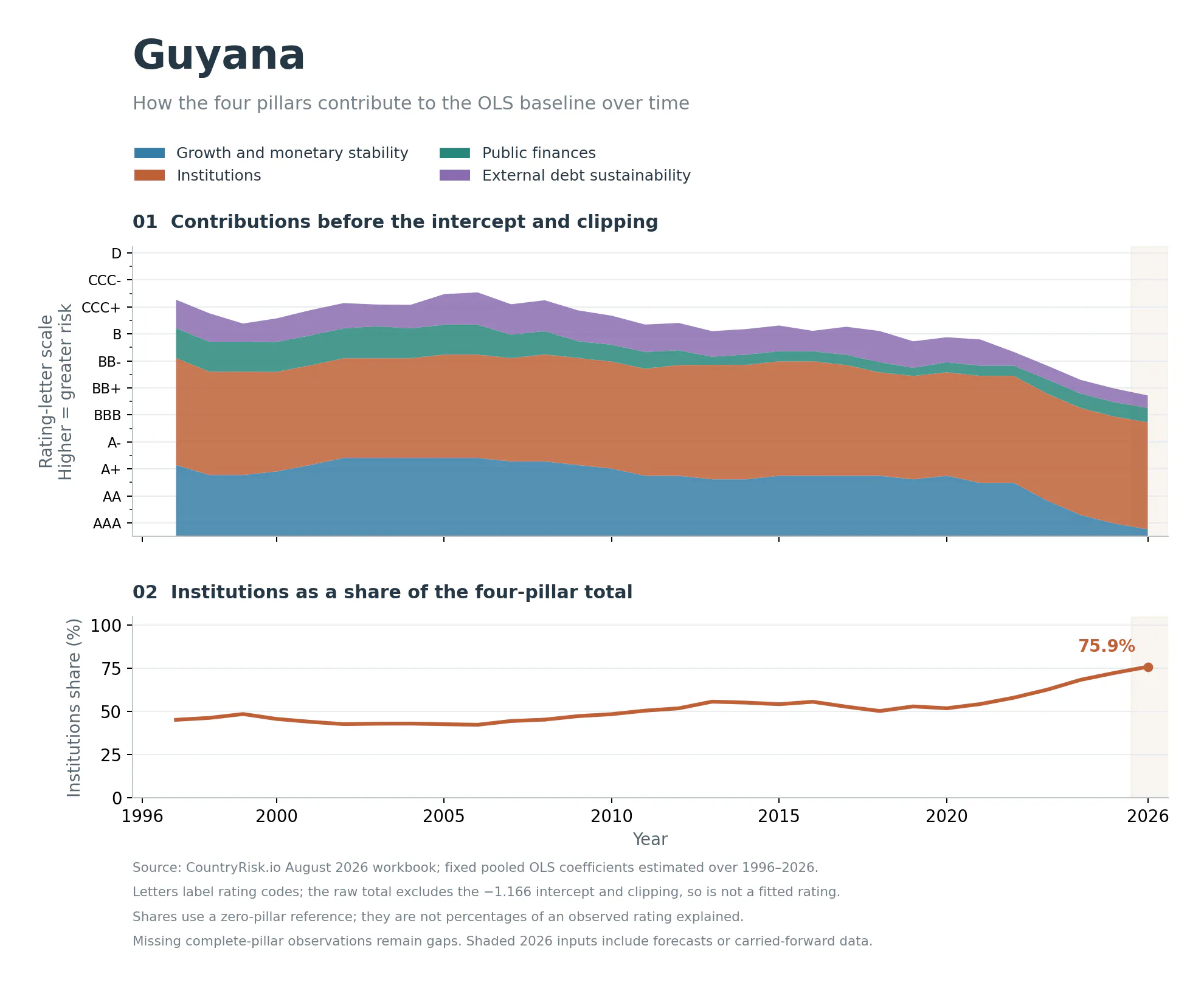
The historical contribution charts show how that mix develops. Each uses the same pooled OLS coefficients in every year, so changes reflect the supplied pillar scores rather than annual re-estimation. The upper panel shows the four raw contributions in rating-code points; the lower panel shows institutions as a share of their total. The intercept and clipping adjustment remain outside the plotted total.
Türkiye illustrates a growing institutional share as other risks recede. Between 2000 and 2026, growth risk falls from 46.1 to 13.3 and public-finance risk from 57.0 to 26.0, while institutional risk rises from 67.5 to 72.5. Institutions consequently account for 64.3% of the fitted pillar total in 2026, compared with 46.5% in 2000.
The United Kingdom provides a different profile. Its institutional risk remains low relative to the other pillars, while public-finance and external-debt contributions become more prominent than at the start of the sample. Institutions account for 16.8% of the fitted pillar total in 2026. A zero contribution in earlier years reflects the supplied risk score and the model's zero-score reference; it does not mean institutions were irrelevant to creditworthiness.
Annual data, using fixed coefficients estimated over 1996–2026. Missing complete observations remain gaps. Shares describe fitted pillar contributions, not percentages of an agency rating explained. View the charts and download the data.
An unrated country still has an institutional profile
Guyana makes this particularly visible. The August 2026 workbook records no agency rating for Guyana, but it contains all four CountryRisk.io pillar scores. Its economic-pillar average is 19.0, while its institutional risk score is 72.5. It sits 31.2 points above the institutional trendline fitted to rated economies.
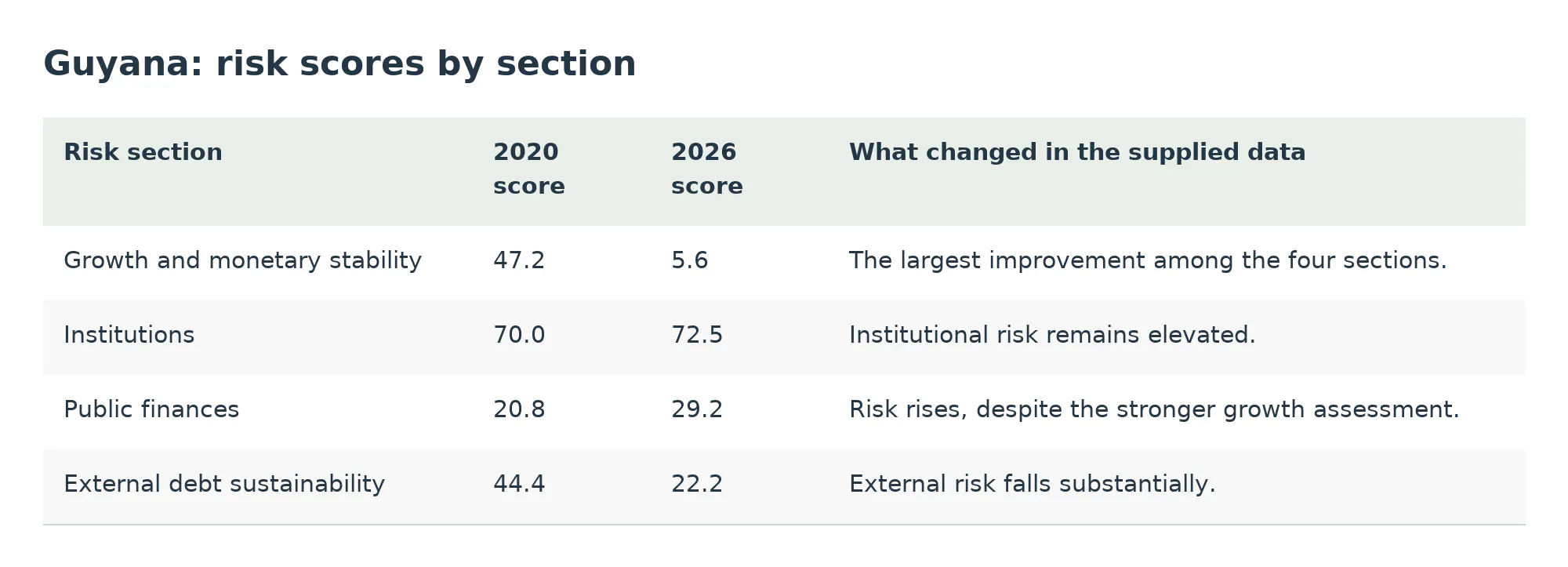
The contrast is visible across the individual risk sections:
Higher scores indicate greater risk. These are composite pillar scores, not GDP growth rates or debt ratios; 2026 inputs include forecasts or carried-forward observations.
Guyana's oil expansion provides context for the economic transformation. The IMF's 2025 Article IV assessment describes rapidly increasing oil production, strong non-oil activity and substantial infrastructure investment. It also records a widening fiscal deficit as capital spending increases, while assessing debt-distress risk as low. Stronger growth, larger spending commitments and the capacity to manage them can therefore develop together. The pillar scores summarize aspects of that changing profile; they do not isolate the effect of oil on each risk section. IMF, Guyana 2025 Article IV consultation.
In the OLS baseline, institutions rise from 51.9% of Guyana's fitted pillar total in 2020 to 75.9% in 2026. Much of that increase comes from the lower risk contribution from the growth and external factors, alongside the small rise in institutional risk. This is why contribution shares need to be read with their underlying scores. The practical questions concern the institutions managing the expansion: how investment projects are selected, contracts awarded, public resources monitored and implementation documented. The aggregate score identifies an area for investigation; it cannot establish which specific process is deficient.
Follow the governance score back to its sources
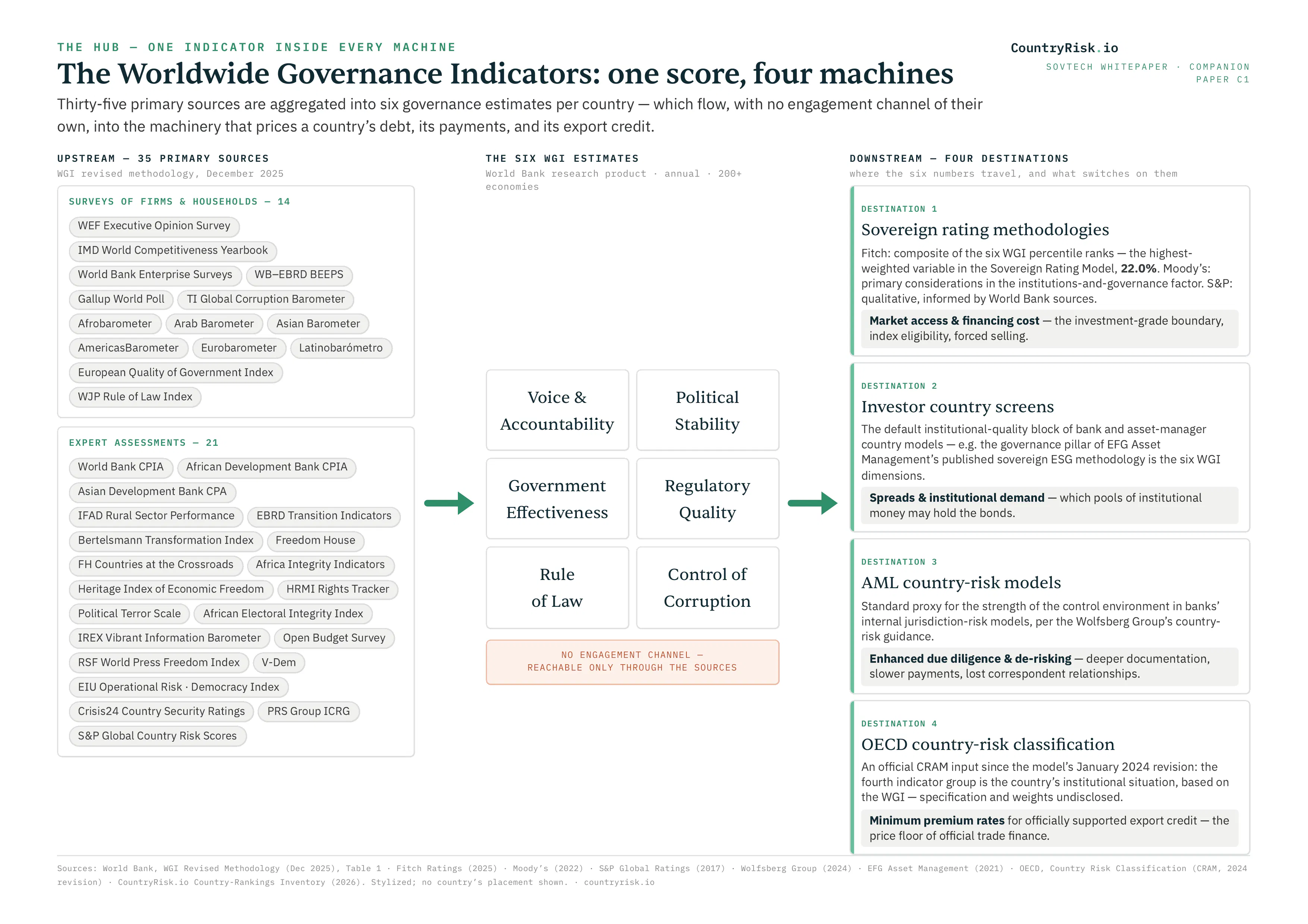
The WGI number is itself an aggregation. The current methodology combines 35 sources—14 surveys of households and firms and 21 expert assessments—into six governance estimates, with measures of uncertainty. Source coverage differs across countries. The resulting score summarizes evidence; it does not identify a single administrative failure or prescribe a reform. World Bank, 2025 methodology revision.
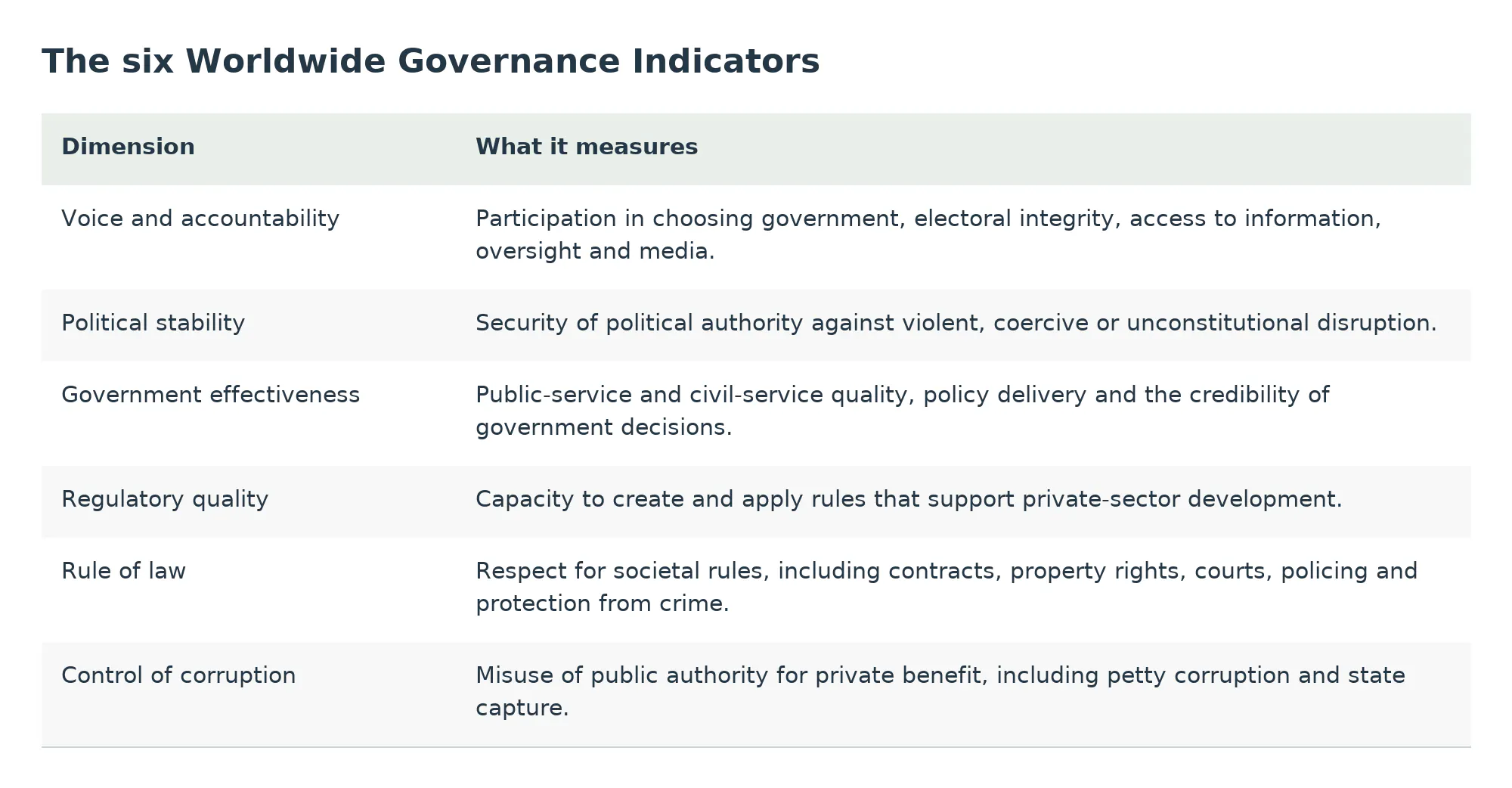
The six dimensions describe distinct aspects of institutional life. Each is an estimate of perceptions drawn from the underlying evidence:
Definitions summarized from the revised WGI methodology, p. 7.
The illustration below traces the relationship from the source assessments through these six dimensions to their use in ratings, investor models, AML risk assessments and export-credit classifications.
A government looking at an unfavourable institutional score therefore has several layers to work through. Which dimensions are weak? Which underlying sources cover the country? What period do their observations describe? What evidence would show whether conditions have changed?
This is where the practical difficulty lies. Perceptions may move slowly after reforms. Surveys and expert assessments observe different parts of institutional life. An aggregate can conceal disagreement between sources, and small movements can be difficult to distinguish from measurement uncertainty.
Two gaps, and a government function to distinguish them
The first possibility is a performance gap. Courts may be slow, regulations applied inconsistently, procurement poorly controlled or public administration unreliable. Those deficiencies require substantive changes. Better documentation matters because it allows implementation and results to be assessed, but documentation cannot deliver the reform itself.
The second possibility is an information gap. Relevant evidence may be unavailable, outdated or difficult to verify. A reform may have been enacted but its implementation not documented. A published assessment may refer to a period before a material change. Establishing such a gap requires examining the source and its evidence; a disappointing score is not proof that the assessor is wrong.
The performance and information gap often coexist.
Give external assessments a central owner
A government needs a central gatekeeper for this work: a mandated function with the authority to coordinate evidence across ministries and maintain relationships with external assessors. It could sit in the cabinet office, a delivery unit or another body with a credible cross-government remit. Its purpose is to make sure consequential assessments have named owners, reliable evidence and a maintained institutional record.
The function should begin with an inventory: which assessments matter, what they measure, where their inputs originate, when they are updated and which decisions use them. Our white paper, When Country Rankings Become a Managed Portfolio, catalogues around 100 external country assessments, ranging from reputational signals to classifications with direct consequences for financing, eligibility and regulatory obligations. The white paper is available on request. Mapping shared inputs is particularly useful. The same governance evidence may appear in a rating methodology, an investor model and an export-credit assessment, while the domestic responsibility for that evidence is spread across several agencies.
The next task is to connect each identified issue to action. A performance weakness needs a responsible institution, an implementation plan and evidence of results. A potential information gap needs a documented factual check and, where warranted, a correction through the provider's available channel.
The gatekeeper should retain the submissions, source data, methodology versions, correspondence and decisions from each assessment cycle. It should also ensure that public evidence is dated, accessible and sufficiently structured for both analysts and automated systems to use. That continuity prevents the government's external record from depending on a single official or a hurried response to the next review.
An AI-powered central knowledge management and engagement platform can reduce the operational burden of maintaining this function. It can bring methodologies, source evidence, assessment calendars and correspondence into one place; help identify shared inputs and changes; and prepare evidence-linked briefing notes and draft responses for officials to review. By reducing repetitive research and coordination work, such a platform can enable even small countries with limited administrative capacity to sustain a constructive and informed dialogue with external assessors. Officials remain responsible for the evidence, policy decisions and representations made on the country's behalf.
Success should be judged by the quality of the process: substantive weaknesses assigned and addressed, evidence published, errors checked, deadlines met and changes followed through. A government cannot guarantee a favourable external judgment. It can take responsibility for understanding how that judgment is formed, improving the institutions behind it and ensuring the evidence is available when the assessment is made.