See how Fitch, Moody’s, and S&P may interpret a government policy proposal before it reaches the rating committee.
Bernhard Obenhuber Jun 15, 2026
Government policy proposals often reach debt management offices before they reach rating agencies. A tax measure, subsidy, pension reform, infrastructure program, debt operation, or central-bank reform can all raise the same practical question:
How would Fitch, Moody’s, and S&P likely view this from a sovereign rating perspective?
That question is harder than it looks. Rating agencies do not assess policies in isolation. They map them into sovereign methodology frameworks: fiscal strength, debt sustainability, institutional credibility, growth effects, external vulnerability, monetary flexibility, event risk, and sometimes ESG or climate exposure. The same policy can be positive under one channel and negative under another.
That is why we built a sovereign rating policy-impact skill for the CountryRisk.io insights platform.
Disclaimer: The skill provides an indicative, methodology-based assessment. There is no guarantee that Fitch, Moody’s, S&P, or any other rating agency would reach the same conclusion, apply the same weighting, or take the same rating action.
Motivation
A government debt management office needs more than a generic macroeconomic opinion. It needs an agency-specific assessment that answers questions such as:
Which rating factors does this proposal affect?
Is the effect likely fiscal, institutional, external, monetary, or event-risk related?
Would the policy matter for the rating itself, the outlook, or only the agency narrative?
What evidence should the government prepare before engaging with analysts?
How might the three major agencies differ in their interpretation?
The goal of the skill is not to “predict” a rating action. Rating committees retain discretion, and agency methodologies combine quantitative scorecards with qualitative judgment. The goal is to produce a disciplined, methodology-grounded assessment that helps governments prepare better policy analysis and rating-agency communication.
How The Skill Was Implemented
The skill was built around the current sovereign rating methodologies from:
Fitch Sovereign Rating Criteria, 27 April 2026
Moody’s Sovereigns methodology, 27 May 2026
S&P Sovereign Rating Methodology, republished 9 January 2026
Each methodology was converted into a clean Markdown resource file. The raw PDF and HTML conversions were useful, but not equally clean. Some wide tables, especially S&P’s indicative rating matrix and Moody’s scorecard tables, needed verification and repair from the HTML source. Broken image links and boilerplate contact information were removed so the resources focus on methodology content.
The final skill contains:
A concise workflow file: SKILL.md
Agency methodology resources for Fitch, Moody’s, and S&P
A methodology crosswalk mapping comparable agency concepts
A memo template for policy-impact assessments
The crosswalk is important. It lets the skill route a policy proposal to the right methodology sections.
Example: Austria VAT Reduction On Household Staples
To test the skill, we used the following policy proposal:
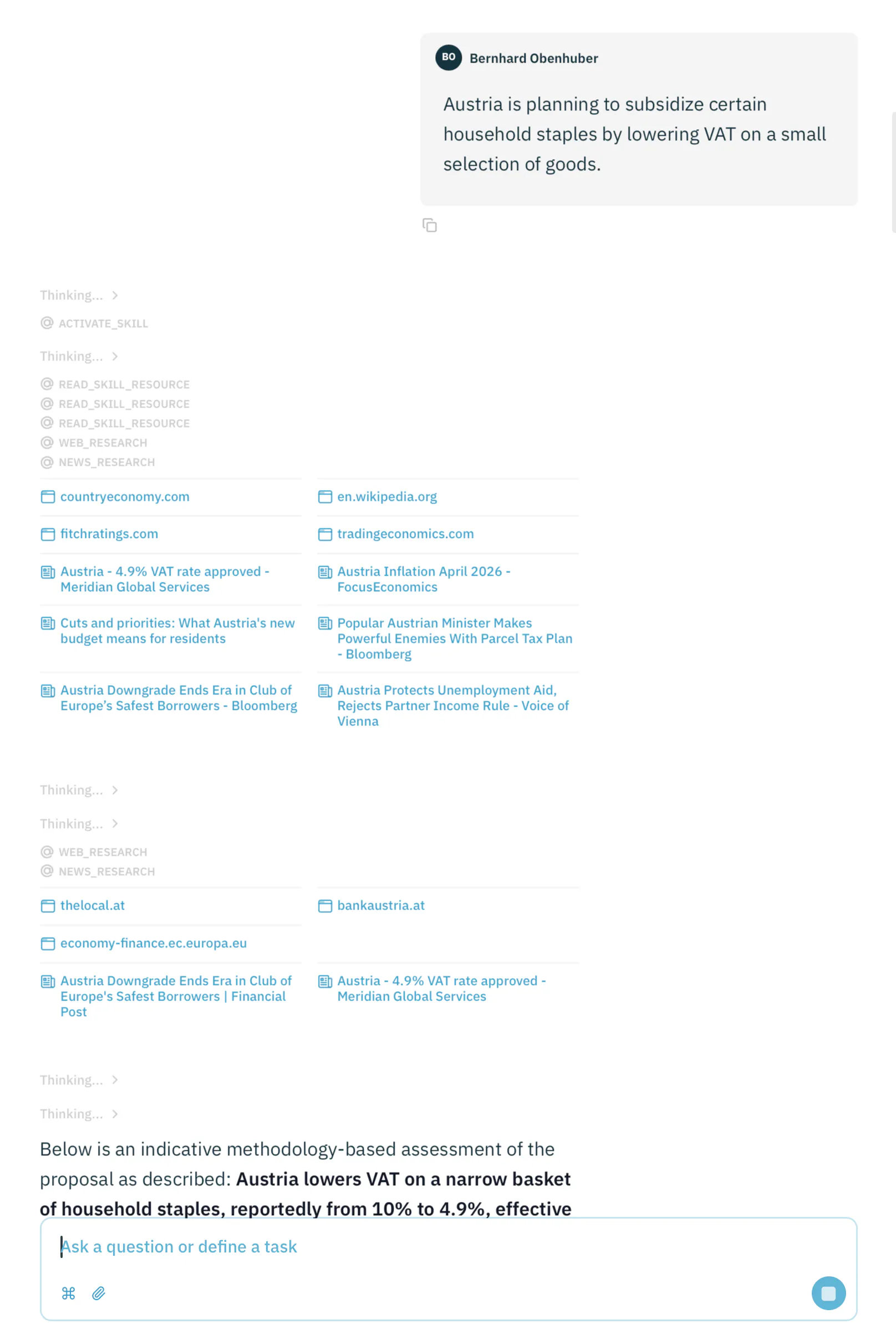
Austria is planning to subsidize certain household staples by lowering VAT on a small selection of goods.
We head over to the CountryRisk.io Insights platform; open the AI Assistant and select the newly-added skill from the quick-action menu.
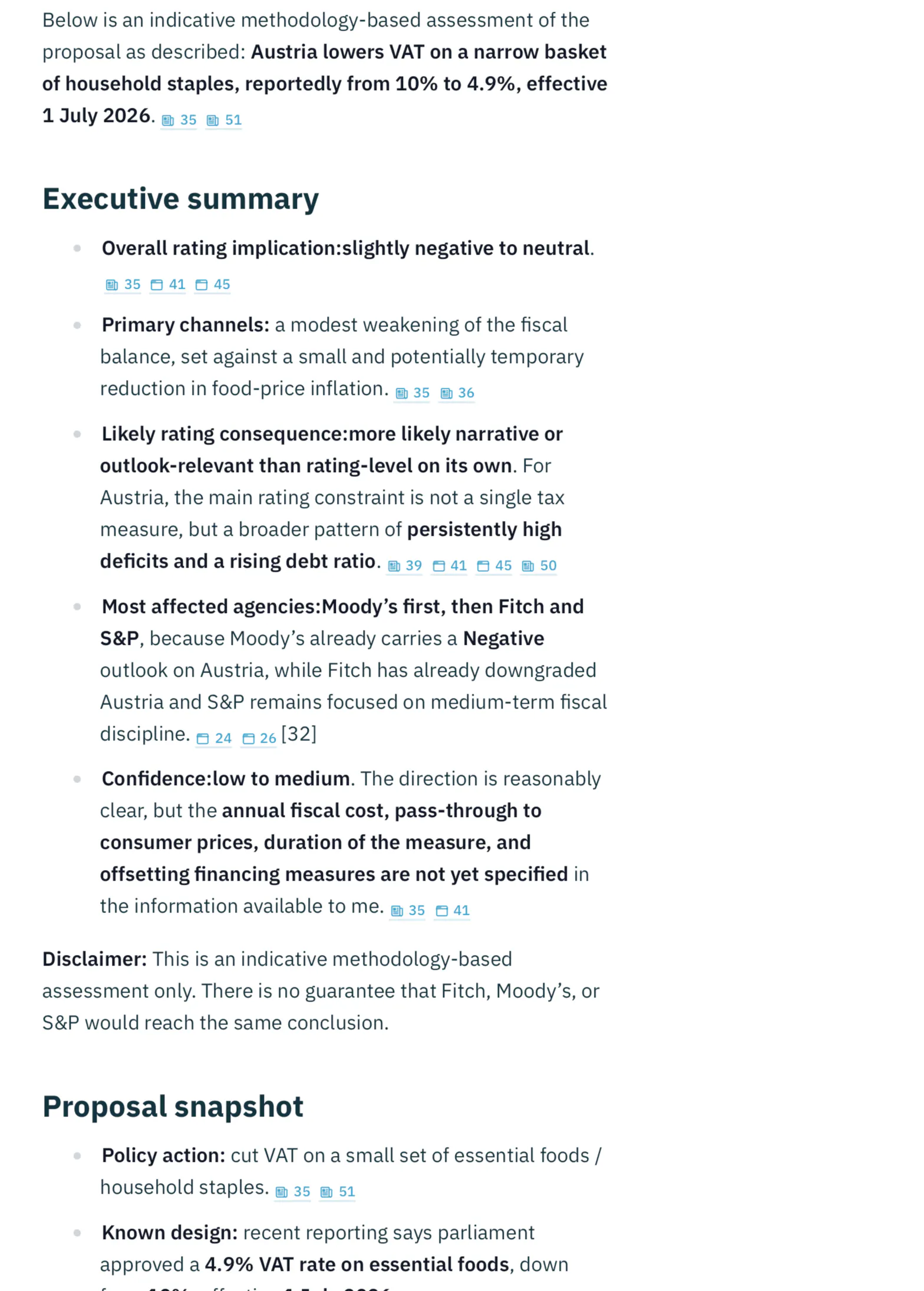
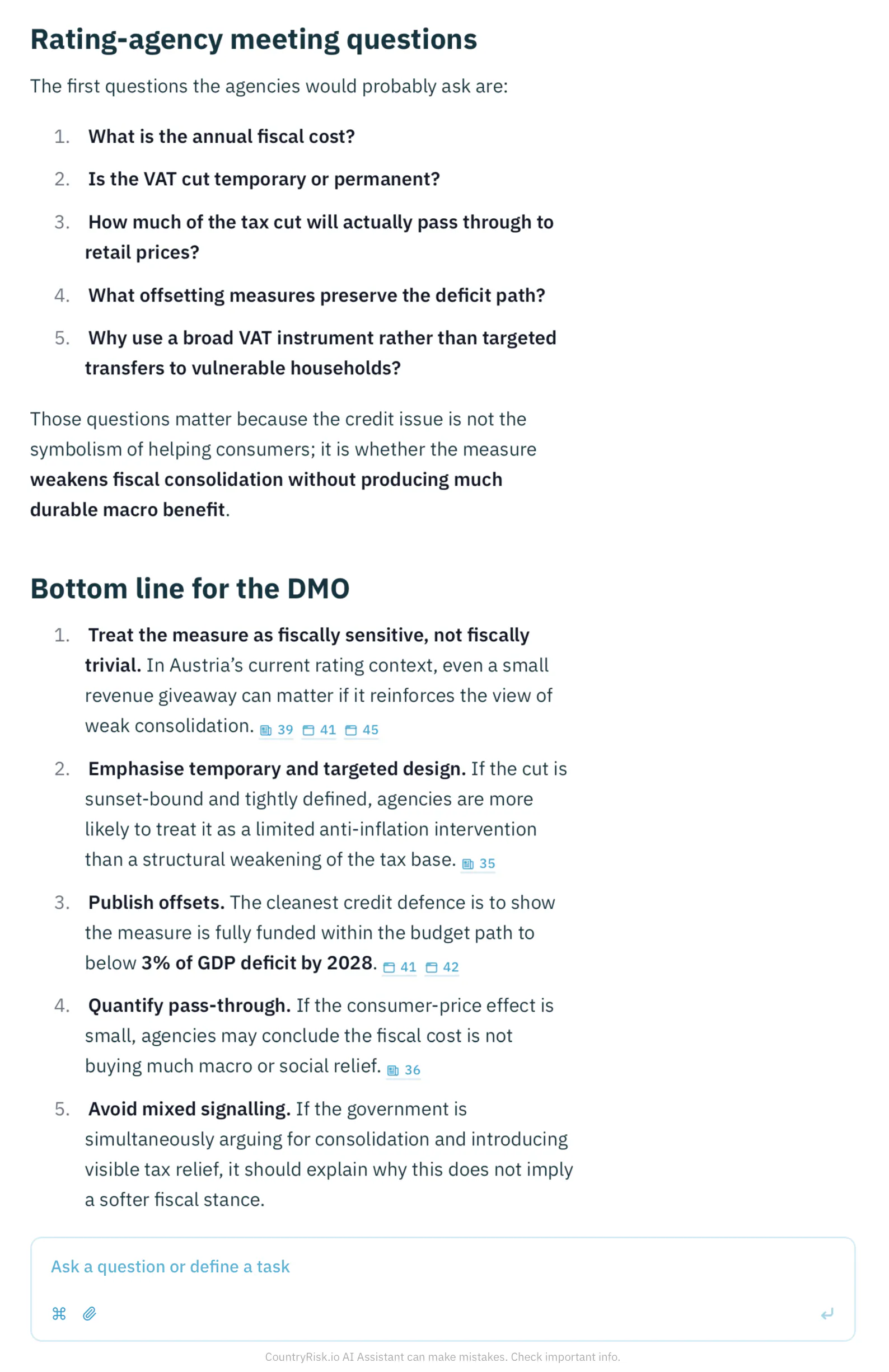
The AI Assistant activates and reads the skill. It also conducts a quick news and web-search to learn more about the new government policy. It then produces the output as described in the respective skill-resource file.
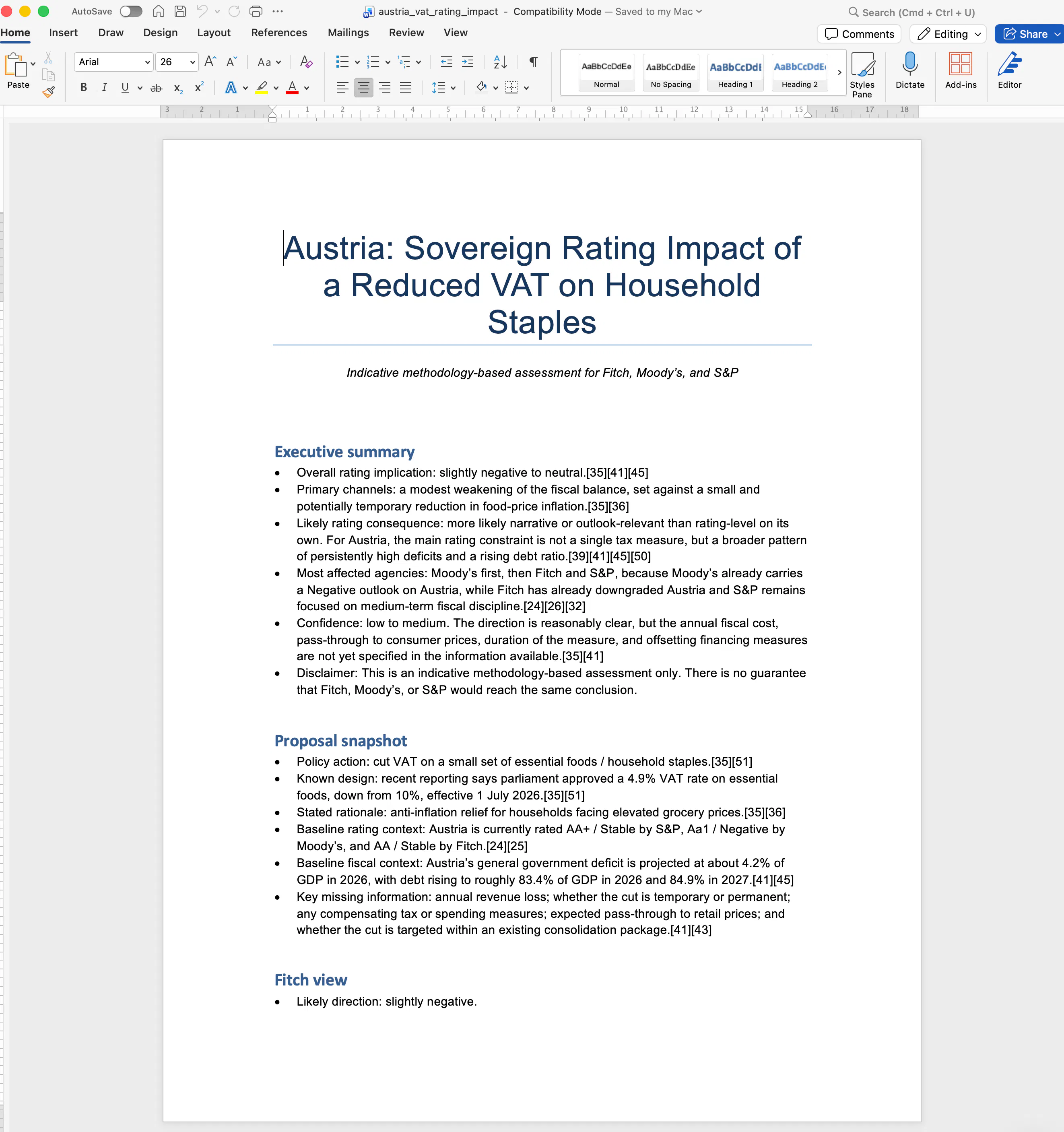
The AI Assistant is also capable to put everything into a word-document that can be further edited and shared with colleagues throughout the organisation.
Why This Matters
Sovereign rating analysis is often framed as a periodic review exercise. In practice, rating implications emerge continuously as governments design and announce policy.
A skill like this helps move rating analysis upstream. Before a proposal is announced, policymakers can understand how agencies may interpret it, what risks need to be mitigated, and what evidence should be prepared.
For debt management offices, that is the main value: not replacing rating-agency judgment, but improving the government’s ability to anticipate it.
It also helps to prepare for a rating review meeting with the agencies. In the given example, the skill also supports the DMO with action and talking points.
Get In Touch
Contact the CountryRisk.io team to get access to the Sovereign Rating Policy-Impact Skill and see how it can support your policy, debt-management, and rating-agency preparation workflows. We can also help you design custom skills for your own use cases, from sovereign risk monitoring and investor briefings to fiscal policy analysis, early-warning systems, and internal research automation.