Sovereign Investor Relations Is a Credibility Engine — And AI Can Finally Make It Affordable
How we turned the World Bank’s new guide for debt managers into an AI skill, and why that matters for every capacity-constrained debt management office.

Bernhard Obenhuber
Jul 15, 2026

The World Bank has just published one of the most practical documents to appear in the sovereign debt space in years: Sovereign Investor Relations: A Guide for Debt Managers (Proite & Yavuz, 2026). You can find the paper here: Link. It is not a policy manifesto. It is a working manual — decision trees for choosing an investor relations setup, job descriptions, a full strategy document template, crisis protocols with escalation triggers measured in hours, and step-by-step guidance for the moments that matter most: rating agency due diligence, liability management operations, and debt restructurings.
We read it cover to cover. Then we did something with it that we think points at the future of technical assistance: we turned it into an AI skill. More on that below — but first, why this function deserves the attention.
The case for investor relations is quietly overwhelming
Sovereign investor relations (SIR) sounds like a soft discipline — websites, roadshows, slide decks. The evidence says otherwise.
Investors price uncertainty. When information about a sovereign is scarce, stale, or inconsistent, they add an uncertainty premium to its borrowing costs — and they run faster in stress. Gelos and Wei showed years ago that mutual funds hold less of opaque countries and withdraw from them more quickly in a crisis. More recent BIS research (Fang, Hardy & Lewis, 2023) quantifies the stakes: for an average emerging market borrower, a 10 percent increase in debt raises yields by 6.7 percent when information-sensitive non-bank investors are in the base — but by 9.1 percent when they are absent and the sovereign must rely on banks. Keeping diverse, information-hungry investors engaged is not cosmetic; it is the cheapest form of yield compression available.
The World Bank guide adds the arithmetic that should end any budget debate: 50 basis points saved on a single USD 500 million bond is USD 2.5 million per year. A lean investor relations function costs a fraction of that. The IIF’s data show countries with top-tier IR programs enjoy more stable credit ratings. Peru made investment grade an explicit policy objective in 2006 and — with disciplined fundamentals and coordinated communication — got there within four years. Guatemala’s 2024 “Roadmap to Investment Grade” contributed to an upgrade within a year.
And when things go wrong, communication is the difference between an orderly workout and a value-destroying one. Ecuador’s 2020 restructuring closed in roughly six months with 98 percent participation, helped by early, transparent sharing of its debt sustainability analysis with all creditor groups. Ghana and Sri Lanka ran dedicated restructuring pages, successive FAQs, and senior-led updates that kept creditors coordinated instead of fragmented.
This is why we describe investor relations the way the World Bank guide does: a credibility engine. It converts transparency into lower risk premia.
The uncomfortable part: the countries that need it most can least afford it
Here is the tension the guide is honest about. The full SIR agenda — a strategy document, a stakeholder tiering, a publication calendar, investor presentations, CRA data packs, crisis protocols, KPI dashboards, all maintained continuously in two languages — is a serious operational commitment. And the baseline capacity picture is sobering: World Bank DeMPA assessments from 2020–25 found roughly half of assessed countries failing good practice standards on basic debt reporting content and timeliness.
We have measured a piece of this gap ourselves. Back in 2024, we ran Google PageSpeed diagnostics across some 300 ministry-of-finance and central-bank webpages in 174 countries (Beep, beep, beep…). The World Bank guide calls the IR website the investor’s “single source of information” — and for a diligent analyst doing primary research, it is literally the front door. What we found: most pages load acceptably, but a long tail takes 20+ seconds to render, and one ministry of finance served over 200 MB of photos on its landing page. If an investor cannot even reach your debt statistics without watching paint dry, the uncertainty premium starts accruing before a single number is read. And that was only the technical layer — before asking whether the borrowing calendar is current or the bulletin still gets published. We promised back then to look at content next; consider this post a down payment.
We see the same pattern in our work with debt management offices. Small teams. High staff turnover that walks institutional knowledge out the door. Data scattered across spreadsheets. IR initiatives that launch with donor support and quietly decay — the website goes stale, the bulletin gets suspended, credibility erodes. Ecuador itself, the guide notes, discontinued its investor relations activities after its restructuring and only resumed them when it needed the market again in 2026. Episodic engagement is almost worse than none: markets notice when you only call when you need money.
So sovereigns face a function that is demonstrably value-creating, largely made of knowledge work, and chronically under-resourced. That combination should sound familiar. It is precisely the profile of work that generative AI is good at.
What AI actually changes here
Look at what an investor relations officer actually does all day: assemble recurring reports from known data sources, keep an investor presentation current, maintain Q&A logs, draft responses to investor and rating agency inquiries, prepare briefing packs before due-diligence missions, summarize meeting notes, track KPIs, keep messaging consistent across documents. The World Bank guide itself lists these as the near-term AI use cases — and notes that while corporate issuers already run AI-powered investor engagement, as of early 2026 no debt management office has publicly deployed such tools. The technology, it says, “is clearly on the horizon.”
We agree — and we think the way it arrives matters. The naive version is a chatbot bolted onto a website. The useful version is different: codify the domain knowledge — the best practices, the templates, the country’s own data and narrative — so that AI works the way a well-trained IR officer would, with humans approving everything that leaves the building.
So we built it: the World Bank guide as an AI skill
To make this concrete, we converted the guide into a skill — a structured package of instructions and reference material that an AI assistant (in our case, Claude) loads on demand. The skill distills the paper’s 71 pages into an operating manual the model actually follows:
- A router that maps a debt manager’s request to the right playbook: draft an SIR strategy, choose between a formal IR unit and a lean setup, prepare a rating agency due diligence, design restructuring communications, build a KPI framework.
- Six reference files distilled from the paper: the Annex 1 strategy template with its stakeholder matrices and crisis protocols; the decision trees and quantitative rules of thumb for institutional setup; the product catalog and the standard investor presentation structure; CRA do’s-and-don’ts and the five-phase due-diligence cycle; the restructuring communications checklist; the monitoring framework.
- Hard guardrails, encoded as instructions: communication supports fundamentals and never substitutes for them; never fabricate statistics; acknowledge risks with mitigants rather than spin; distinguish agreed parameters from indicative assumptions in anything restructuring-related; flag market-sensitive content for internal use and approval workflows.
Rather than describe it in the abstract, here are three real prompts and what comes back.
1. The strategy document — from months to minutes.
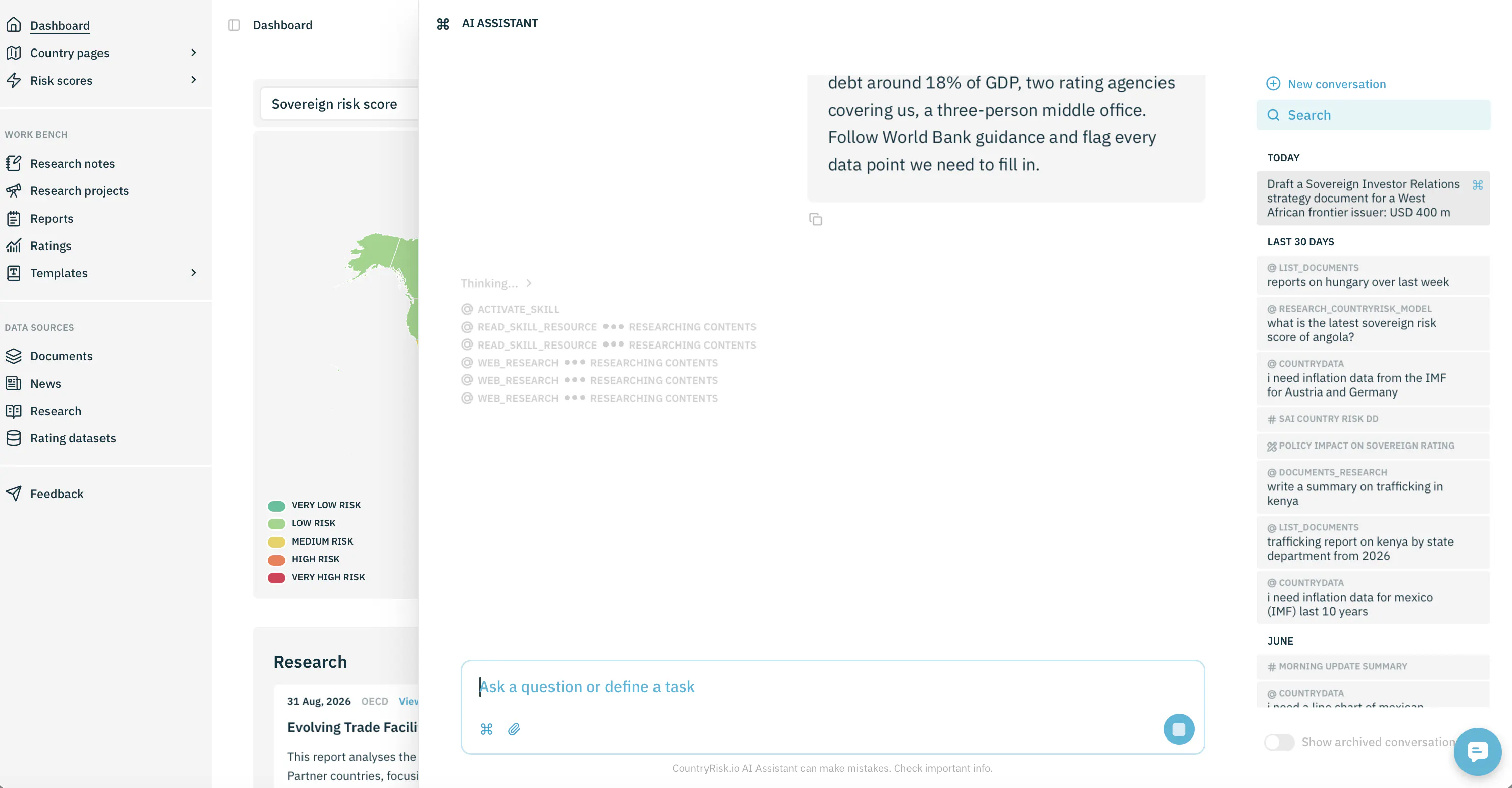
“Draft a Sovereign Investor Relations strategy document for a West African frontier issuer: USD 400 million annual issuance, one Eurobond every 3–4 years, local currency debt around 18% of GDP, two rating agencies covering us, a three-person middle office. Follow World Bank guidance and flag every data point we need to fill in.”
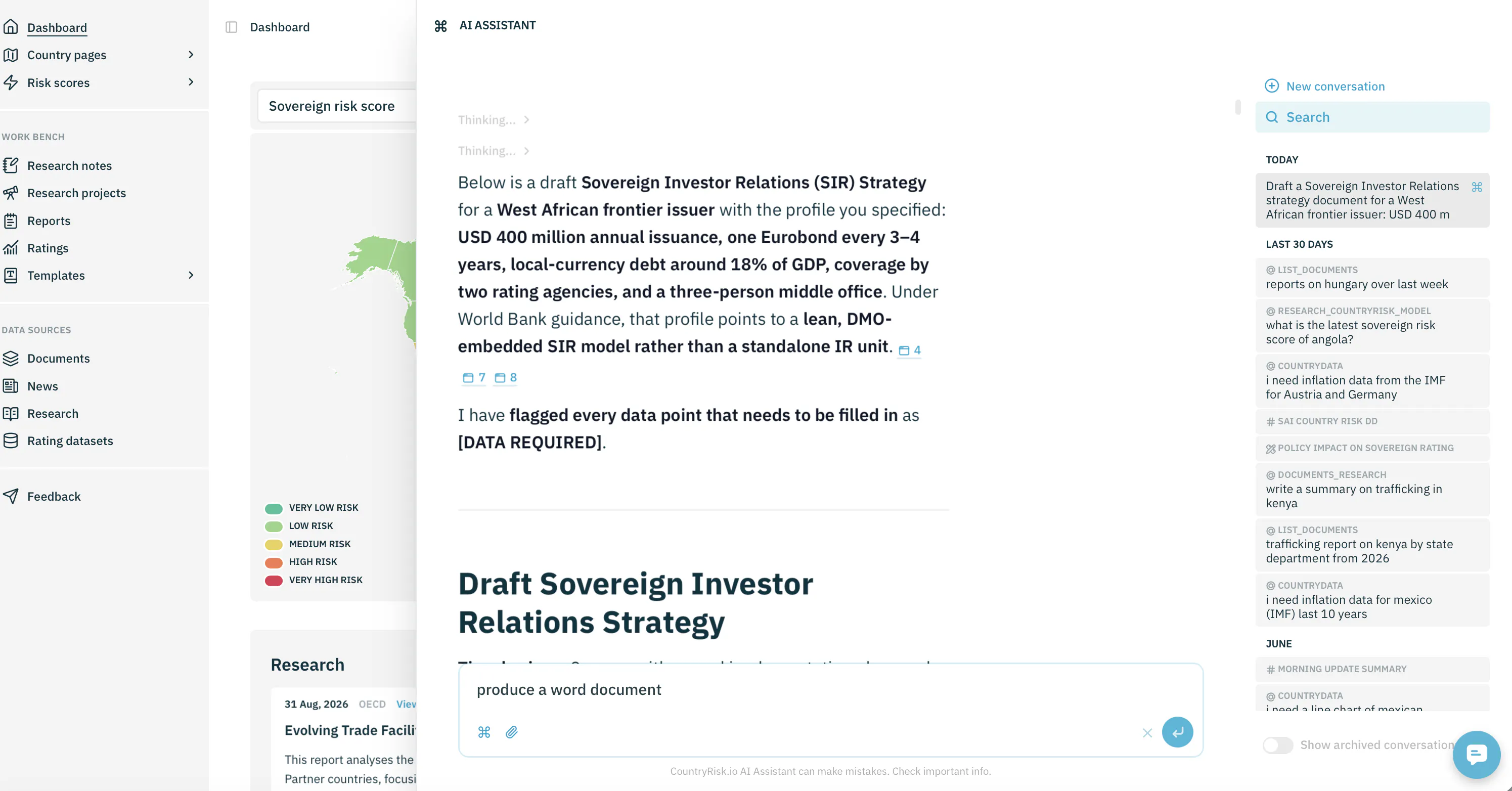
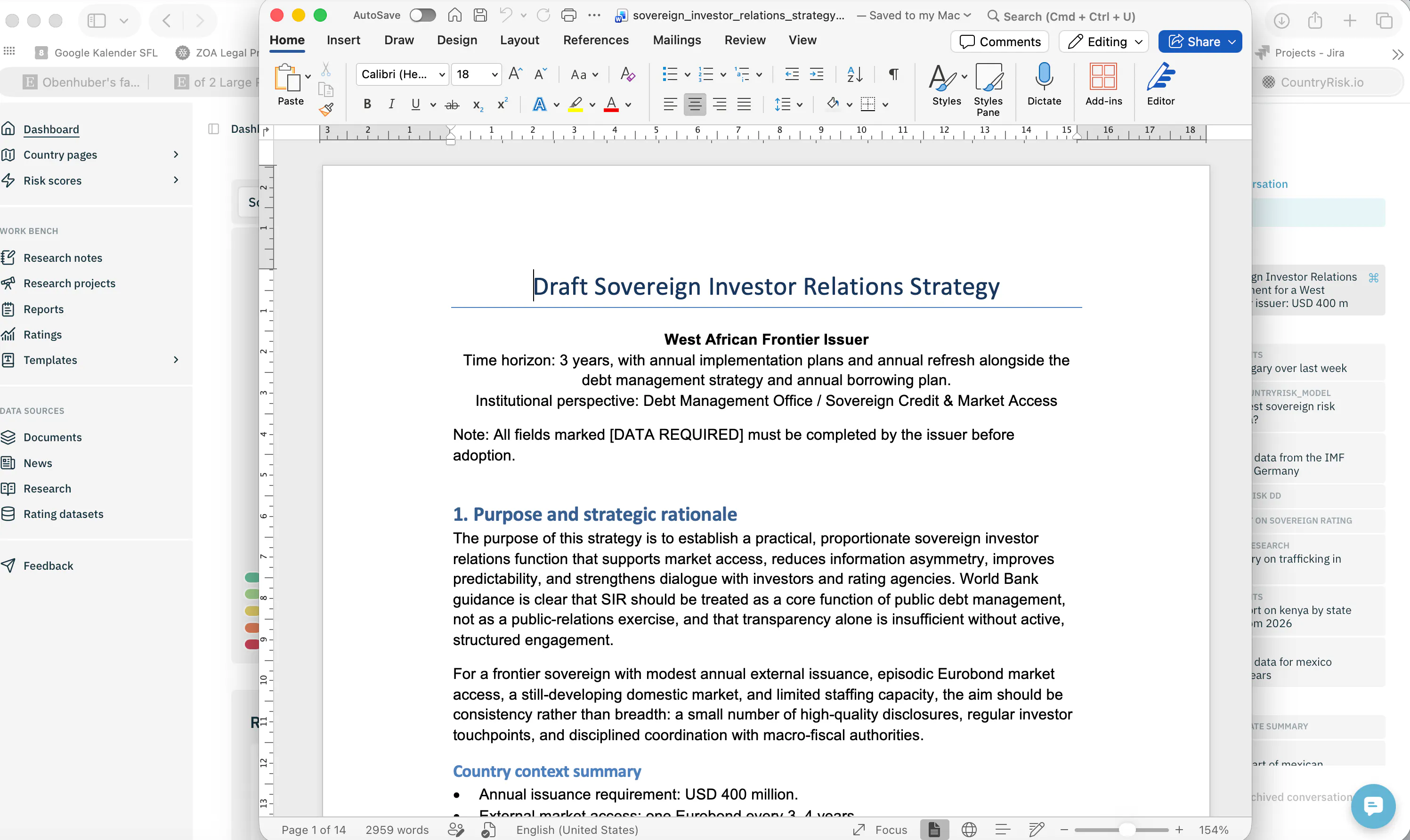
The output follows the guide’s six-component structure — objectives linked to the debt management strategy, governance with a RACI matrix, stakeholder tiers, publication calendar, crisis protocols, KPIs. Just as important is what it does not do: given the issuance profile, it recommends a lean focal-point model, not a formal IR unit this office could never staff. Proportionality is in the playbook, so it is in the output.
2. The technically hard case — buyback or distressed exchange?
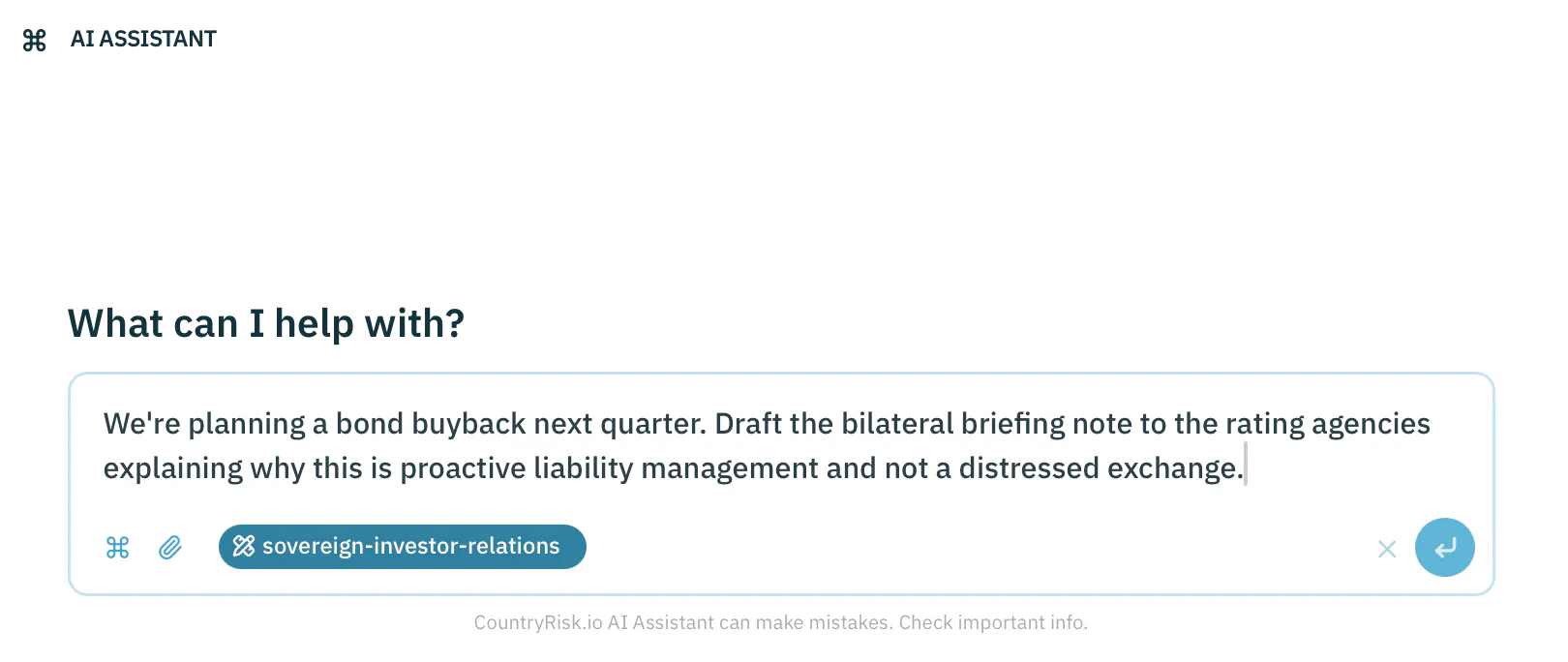
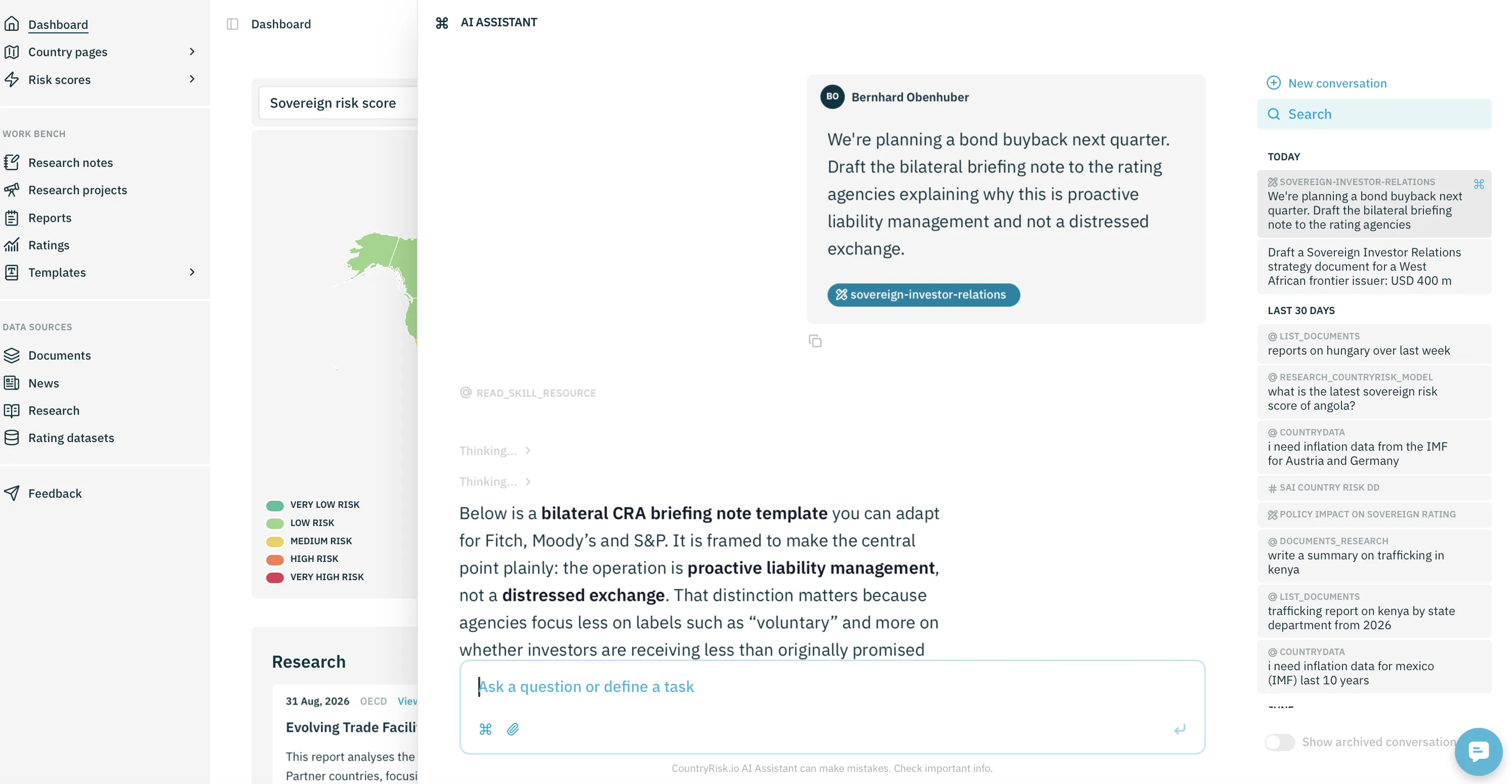
“We’re planning a bond buyback next quarter. Draft the bilateral briefing note to the rating agencies explaining why this is proactive liability management and not a distressed exchange.”
This is where generic AI gets sovereigns into trouble. Rating agencies treat an exchange as a default if investors receive less than promised and a conventional default would otherwise be plausible — the “voluntary” label is largely irrelevant at low rating levels. The skill knows this test, structures the note around buffers and financing alternatives, and prompts for early bilateral engagement — the guide’s exact prescription, and the difference between Serbia and Türkiye (buybacks not classified as distressed) and Argentina (adverse rating action after weak upfront communication).
3. The moment speed matters — a bad auction hits the press.
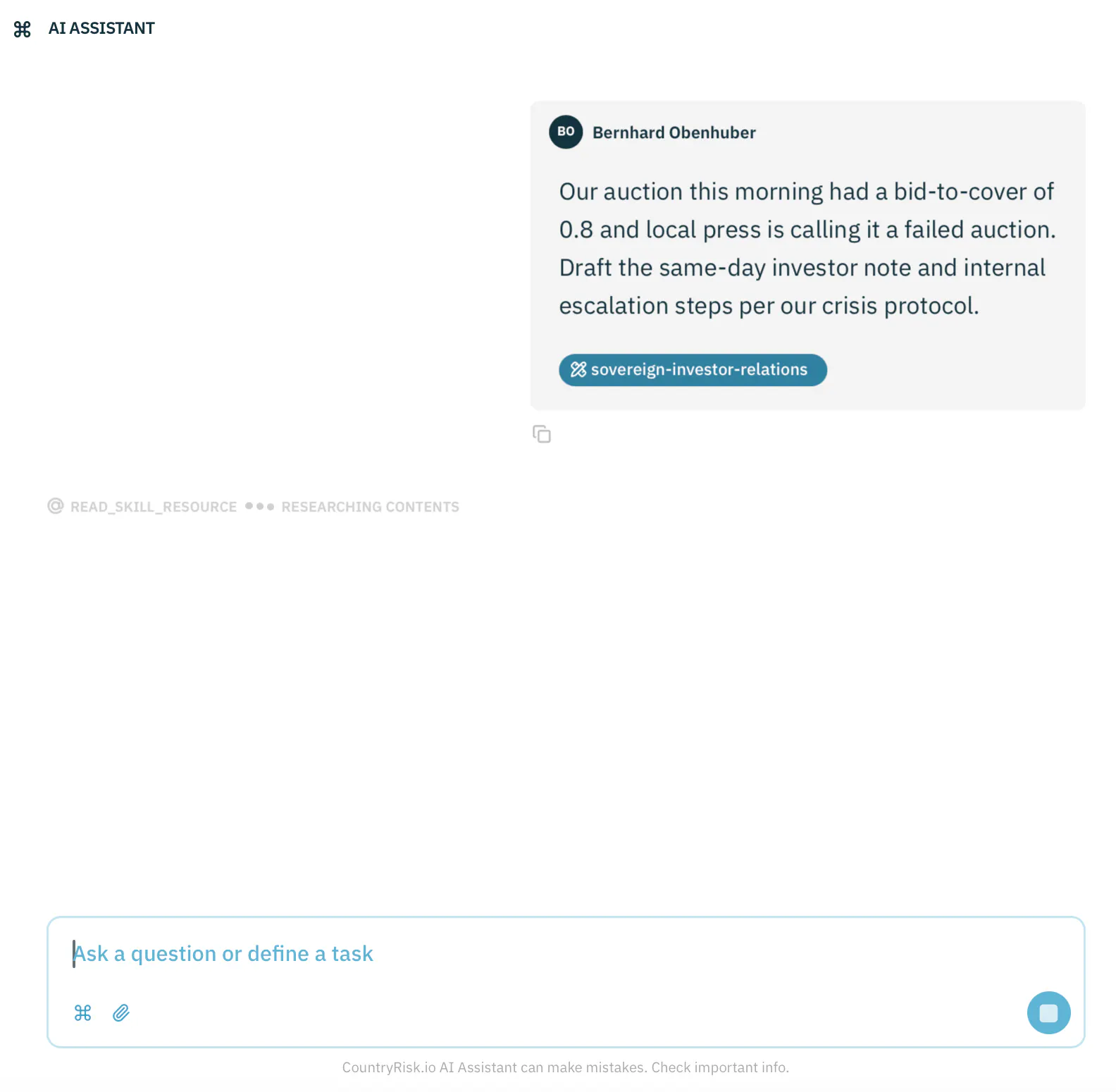
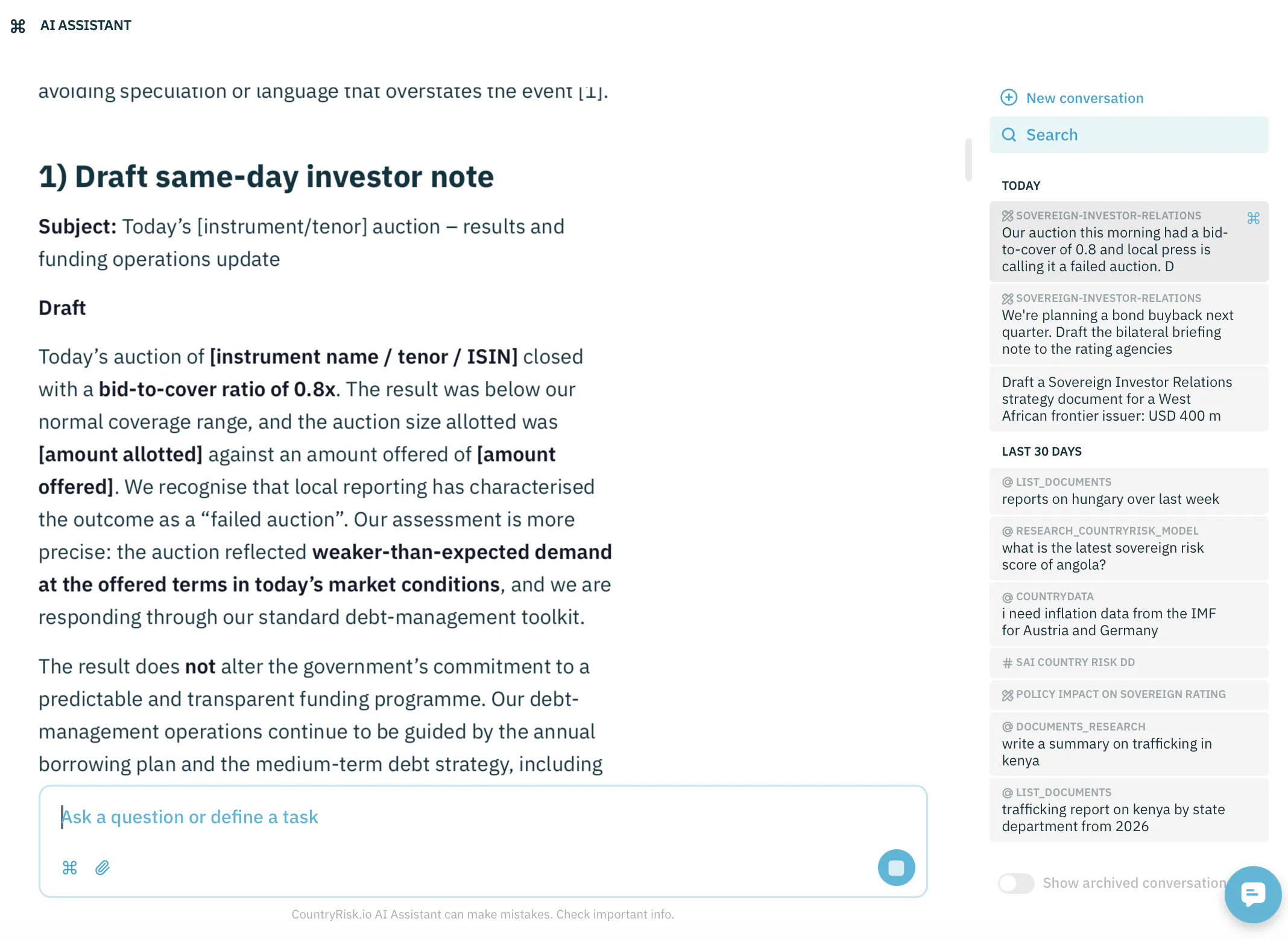
“Our auction this morning had a bid-to-cover of 0.8 and local press is calling it a failed auction. Draft the same-day investor note and internal escalation steps per our crisis protocol.”
Crisis communication is where thin teams get overwhelmed: facts to confirm, messages to clear, Tier 1 investors to call, a press line to hold — all in hours. The skill returns a fact-based draft note plus the escalation sequence (confirm facts → internal alignment → Tier 1 outreach → public statement → monitoring → after-action review), with no speculation and nothing that overpromises.
The point is not that AI writes the strategy. The point is that the marginal cost of starting from best practice drops to nearly zero, and the institutional knowledge stops living only in the heads of staff who may leave next year.
Where this fits in the SovTech stack
This skill is one piece of what we call SovTech at CountryRisk.io — the integration of domain expertise, data, and AI to lower sovereign borrowing costs:
- CountryData.io gives DMOs a structured platform for macro and debt data — their own data alongside standard and alternative sources — shareable with investors and rating agencies through APIs and MCP integrations, so the “single source of truth” the World Bank guide demands actually exists. And loads in under two seconds.
- Our sovereign rating model mirrors the frameworks of the three major agencies, helping DMOs anticipate rating drivers and craft their narrative before the committee meets — exactly the methodology-aware engagement the guide prescribes.
- AI agents and report automation turn the guide’s recurring products — monthly debt bulletins, investor updates, data packs — from staffing burdens into push-button outputs with human review.
- Knowledge bases and digital twins preserve what the analyst knows: the curated research, the analytical frameworks, the country narrative — mitigating the knowledge loss that undermines small offices, and, for multilateral partners, offering a way to deliver best-practice guidance (like this very paper) as a living tool rather than a PDF.
The World Bank guide ends with a call to action: designate an SIR lead, draft and publish the strategy, stand up the unit and the website, start tracking KPIs. We would add one line: and equip that lead with AI that already knows the playbook. The countries with the thinnest teams have the most to gain — and for the first time, the economics work in their favor.
CountryRisk.io works with debt management offices, ministries of finance, and multilateral partners on sovereign risk analytics and AI-enabled investor relations. If you would like to see the skill in action — or discuss codifying your institution’s own knowledge base — get in touch at [email protected].
Reference: Proite, A. & Yavuz, H. (2026). Sovereign Investor Relations: A Guide for Debt Managers — Practical Tools, and Institutional Options for Implementation. World Bank, Prosperity Insight Series.