Taking clues from legal
How will AI reshape macroeconomic and country risk research — and what can economists learn from disruption already unfolding in the legal industry?

Bernhard Obenhuber
Mar 12, 2026

We are sometimes asked how the macroeconomics and country risk research environment is about to change due to technology and artificial intelligence. Is there still a place for economists to read pages of reports, think about the world and form an opinion about the world and its future? The short answer in our view is yes. However, this is not a resounding yes as we also find that the current way of doing research is maintained because of institutional and human inertia. We are already seeing how organisations that embrace data and AI are pulling ahead of those that have not incorporated them into their way of working.
In this blog post, we want to share our thinking and take some clues from another knowledge work field: legal, which seems to be somewhat ahead in the transformation journey.
Legal value chain – disintermediation ongoing
The chart below shows how legal information evolves from political discourse into legislation and case law, which is interpreted by experts and ultimately translated into legal advice that informs business decisions.

In the business context, legal considerations are relevant in nearly every business decision; from hiring employees and developing products to entering new markets. Given the importance, it is not surprising that the legal services market is a trillion-dollar business. For many decades, it has been served by players like LexisNexis, Thomson Reuters, legal publishing houses and of course many law firms that all serve in-house legal teams of corporates. However, over the past two years, this industry has experienced considerable disruption through the emergence of new players like Harvey, Legora and many others that use AI to provide more and more services along the legal value chain shown above. Let’s zoom in on three key services and how far AI disintermediation has already progressed and what the end state might look like:
- Access to legal information: In the past, access to legal information was difficult to obtain. Laws or court decisions were not readily available online but had to be painstakingly collected, structured and disseminated in print. And even as laws became available online, disparate public systems with different metadata justified the existence of service providers.
Today, access to legal information has become a commodity. It still takes effort to access and structure the various legal databases (e.g. Eurlex, SEC filings,..) but the marginal costs have declined significantly. Fancy libraries within law firms have become a thing of the past. - Legal interpretation: A key contribution of legal publishing houses lies in the monitoring, summarization and interpretation of legal information in legal commentaries by experts that is then used by practitioners in law firms or in-house legal teams. The better the reputation of the author or publishing house, the bigger the gravitas and reach.
AI is already able to produce high-quality legal commentaries that incorporate laws, legal decisions and court cases with the very important advantage that AI commentaries can be updated much more frequently than traditional ones. One can even say that there is no longer a need for commentaries produced on a fixed schedule, as they can be generated in real time and take into account the latest developments. - Legal advice: The biggest share goes to general legal advisory work where either law firms or in-house legal teams advise the business divisions or other organisations on how to design and run businesses in a lawful way. Law firms give guidance but also provide contract templates, checklists and other work tools.
When one looks at the service pyramid where reviewing a plain vanilla NDA by a junior associate sits at the bottom and M&A legal advice at the top, AI has already reached the quality to completely replace various layers. And even at the tip, AI is increasingly used (e.g. due diligence, contract review,…). New LegalTech companies typically started as productivity tools for law firms but it increasingly appears that they are Trojan horses, as these LegalTech companies are now going after in-house legal teams and basically taking away market share from the law firms; smart move. Currently, litigation seems to be the safest place for law firms...
Ingredients for success
We see four main aspects that are relevant in the current environment.
- Access to highest quality primary data (e.g. laws, decisions, court cases)
- Monitoring of underlying trends that shape primary data (e.g. parliamentary processes, special interest groups)
- Set of AI skills that general purpose large language models can use to interpret primary data
- Business context and client intelligence (e.g. company & sector information, risk appetite, company history and values)
Macro-research & sovereign risk analysis is different
No, it is not. We would argue that it is actually very similar to the legal value chain. Let’s start with the primary data needed as a foundation for any later analysis and decision. This includes statistical data about all the different aspects from economic to social developments. And as mentioned earlier, information about laws, regulation and public policies that define the rules of the game for long-term prospects but also in the short and medium term such as monetary and fiscal policies. Public policies do not emerge from a vacuum but are a reflection of popular opinion. And not least, events like natural disasters, technological breakthroughs or geopolitical events are relevant.

All this information is picked up by people on the ground who are close to the actual events; they take note, verify, and place it into the immediate context, challenge it. This goes for news but also for collecting survey-based data or understanding the intricate details of economic statistical data. Social media has become a useful addition and source of information but presents a range of other challenges.
The primary data is then used by secondary research providers based in the financial centres of the world who mainly act as another filter and standardization layer to make analysis comparable across countries. The output is then provided to the ultimate consumers of the information who need to make decisions such as building a new factory in a different country, allocating resources based on expected demand, making supply chains more resilient, or managing portfolios and conducting proper risk management. In many cases there are consultancies and advisory firms involved that translate the information into the context of a specific organisation or project.
Generative AI, machine learning, and data more broadly will radically change the middle part of the value chain (i.e. secondary research providers and advisory firms) and the cost of providing such services will drop drastically. Like in the context of legal, the remaining tasks of such companies will be in developing and maintaining the best library of AI analysis skills – including building the best quantitative models. Incumbent research providers are already shifting their investments into alternative (primary) data sources but not many have the scale and technological knowledge for such investments.
CountryRisk.io strategy
At CountryRisk.io we have three principles that guide our strategy.
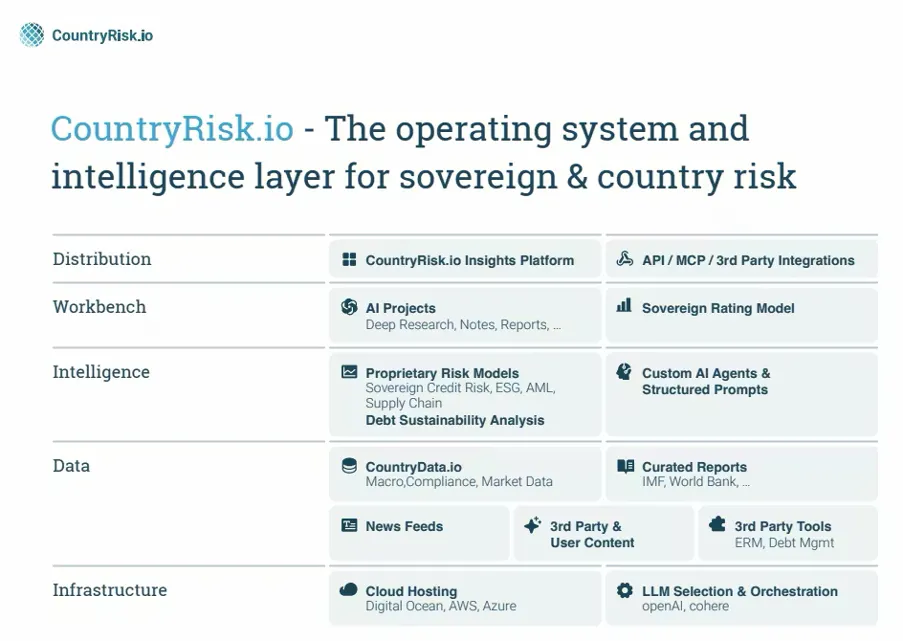
- Be as close as possible to primary data: We built CountryData.io as our data management platform to ingest a wide range of data sources; many of which are not easily available on other data platforms but are highly relevant for specific use cases (e.g. AML country risk monitoring). We also have dedicated and curated data feeds for reports from various sources (e.g. central bank speeches, IMF reports,…) that we all run through a standardized analysis pipeline with a common metadata schema. Finally, we use news feeds and enable third-party data integrations through APIs and MCPs.
- Make implicit knowledge & reasoning explicit: We do not favour storytelling, vagueness or biases in the context of research & analysis. We believe the best way to counter such human tendencies is to make implicit knowledge and reasoning explicit. We do this in the form of quantitative models that reflect our decades of experience and through AI-structured prompts and skills.
- Be relevant through context: Information filtering and application needs to happen through the context of the use case. The risk appetite for entering a new market like for example Tunisia is different for a French, Swedish or Algerian company. Building an economic model that estimates GDP growth is different for a mutual fund with a time horizon of a couple of years than for a pension fund that invests for the ultra-long term. We execute this strategy – and admittedly we can do much better here – by bringing in company data, enabling users to customise AI instructions and by providing workbench features where users actively work and not only consume data.
The chart below shows the various building blocks provided by CountryRisk.io.
Summary
The legal industry offers a compelling preview of what lies ahead for macro research and sovereign risk analysis. Just as AI is restructuring the legal value chain — turning access to legal information into a commodity, automating expert commentary, and steadily climbing the advisory pyramid — the same forces are reshaping how countries and markets are analysed. Secondary research providers and advisory firms that rely on manual synthesis of publicly available information face the greatest displacement, while those closest to primary data and those who can translate analysis into client-specific context will retain their edge. At CountryRisk.io, we are building for this future by combining deep primary data infrastructure, explicit analytical reasoning through quantitative models and AI skills, and contextual relevance tied to each client’s specific decisions. The organisations that will thrive in this new landscape are not those that resist the shift but those that recognise where human judgment still matters — in sourcing and verifying primary information, in encoding domain expertise into reusable analytical frameworks, and in understanding the unique context behind every business decision. The transformation is not coming; it is already here.