The Hybrid Economic Research Team: AI Agents, Data, Models, and Economist Judgment
How AI agents, CountryData.io, empirical models, and economist judgment can turn macro research from a manual note-writing process

Bernhard Obenhuber
May 15, 2026
Economic research is changing from a document-production workflow into a live analytical system. The traditional model is familiar: an economist reads the news, checks the latest data, updates a chart pack, refreshes a model, writes a note, and then repeats the process when the next release arrives. The problem is not that this workflow is broken. The problem is that it is too slow and too manual for the volume and speed of modern macro information.
A more powerful setup is a hybrid economic research team: human economists setting the research agenda and interpretation, supported by AI agents that continuously monitor news, query data, build models, produce charts, and draft commentary. The economist remains responsible for judgment, but the mechanical work of collecting evidence and maintaining analytical infrastructure becomes automated.
From News Monitoring To Research Questions
The workflow starts with news. An AI agent can monitor official releases, central bank communication, market commentary, and reputable news sources. But the goal is not simply summarization. The goal is to monitor news, put it into context through an empirical econometric model and assess whether it confirms or contradicts the existing house view or investment thesis.
We want this to happen in a proactive and autonomuous way that can be implemented at scale. For the following example, the only user input was: "I want that you search the web for news related to the economy of United Kingdom. Analyse it and then build a macro-economic model that can support the understanding of the situation and provide insights that go further than the news. You must only use data available through the CountryData.io MCP. if you cannot find relevant data, look for another research question and try again. also make a note about missing data in CountryData.io that it can be added." This instruction can be active 24/7.
In the UK example, the news flow contained two competing signals. On one hand, official GDP data pointed to a growth rebound. On the other, Bank of England commentary and market coverage focused on inflation risks, energy shocks, and the possibility that rates would need to remain restrictive. A human economist might frame the question as: "Is the UK entering a cleaner growth recovery, or is this better understood as a stagflation-risk episode?"
That is the key shift. The AI agent does not just say what happened. It turns the news into a testable macro question.
Agents That Query Data
Once the question is defined, the next agentic task is data discovery. The agent should ask: what data do we actually have, at what frequency, with what history, and from which source?
For the UK case, the model used only data available through CountryData.io:
- CPI headline and component indexes
- CPI basket weights
- short-term rates
- unemployment
- business confidence
- consumer confidence
- long-term yields
- oil prices
This matters because the model is only as reliable as the data pipeline behind it. A note based on manually copied data is hard to reproduce. A note based on a systematic data query can be refreshed, audited, and extended.
Why CountryData.io MCP Is Critical
The CountryData.io MCP is a critical implementation element because it turns data access into an agent-readable interface. Instead of asking an analyst to remember source URLs, API parameters, indicator codes, country identifiers, release calendars, and dataset quirks, the AI agent can query CountryData directly, inspect available indicators, retrieve observations, and document missing data.
This is what makes the hybrid research setup operational rather than theoretical. The MCP gives agents a controlled path to structured macro data. It also creates discipline: if the data are not available in CountryData, the agent must say so, record the gap, and either adapt the research question or recommend a dataset to add. That is exactly what a serious research process needs.
In the UK example, the agent found enough data to build an inflation-pressure and macro-tension model. It also identified missing data that would improve the analysis, including monthly GDP by sector, wage growth, household energy price caps, the market-implied Bank of England policy path, and a richer fiscal impulse series. That missing-data note is not a failure. It is a product feature: it tells the data platform what would unlock better research.
Agents That Build Models
The next layer is model construction. The agent can build a compact empirical model that maps the news question into observable variables.
For the UK, the model had three blocks:
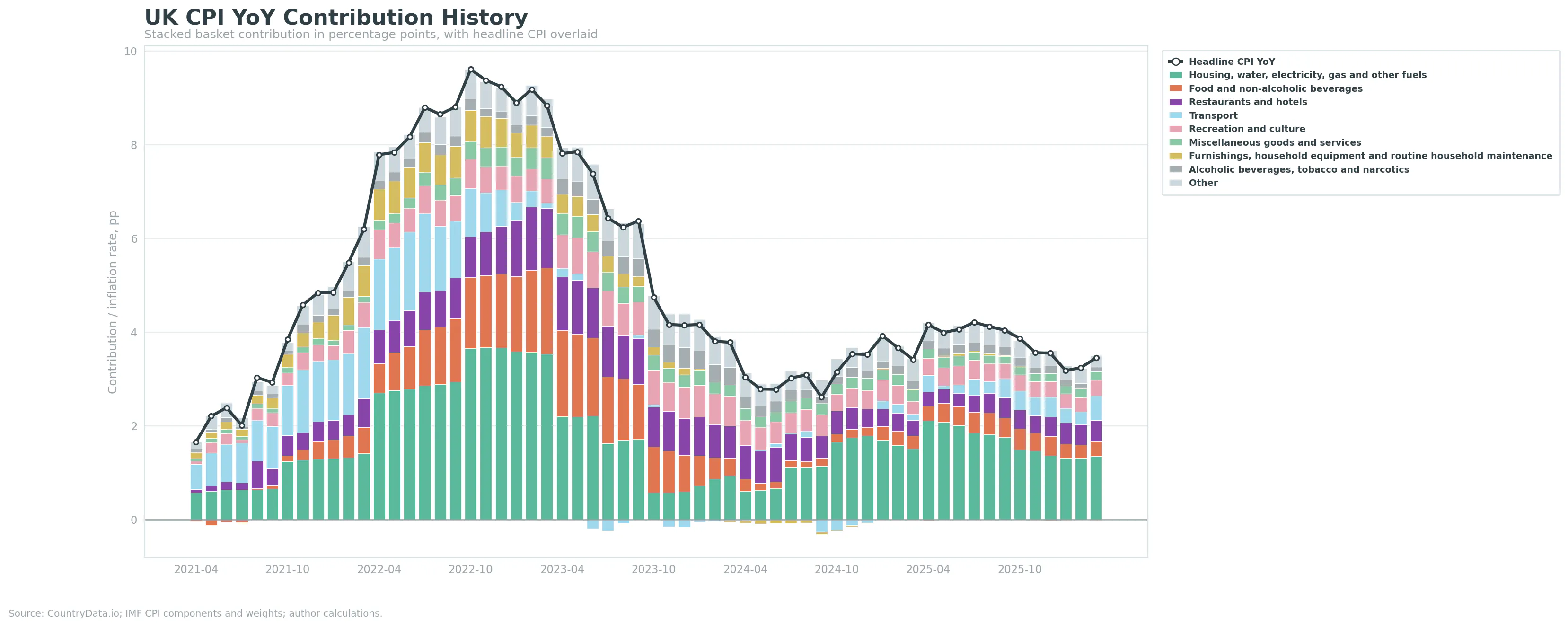
- A weighted CPI contribution model using CPI components and basket weights.
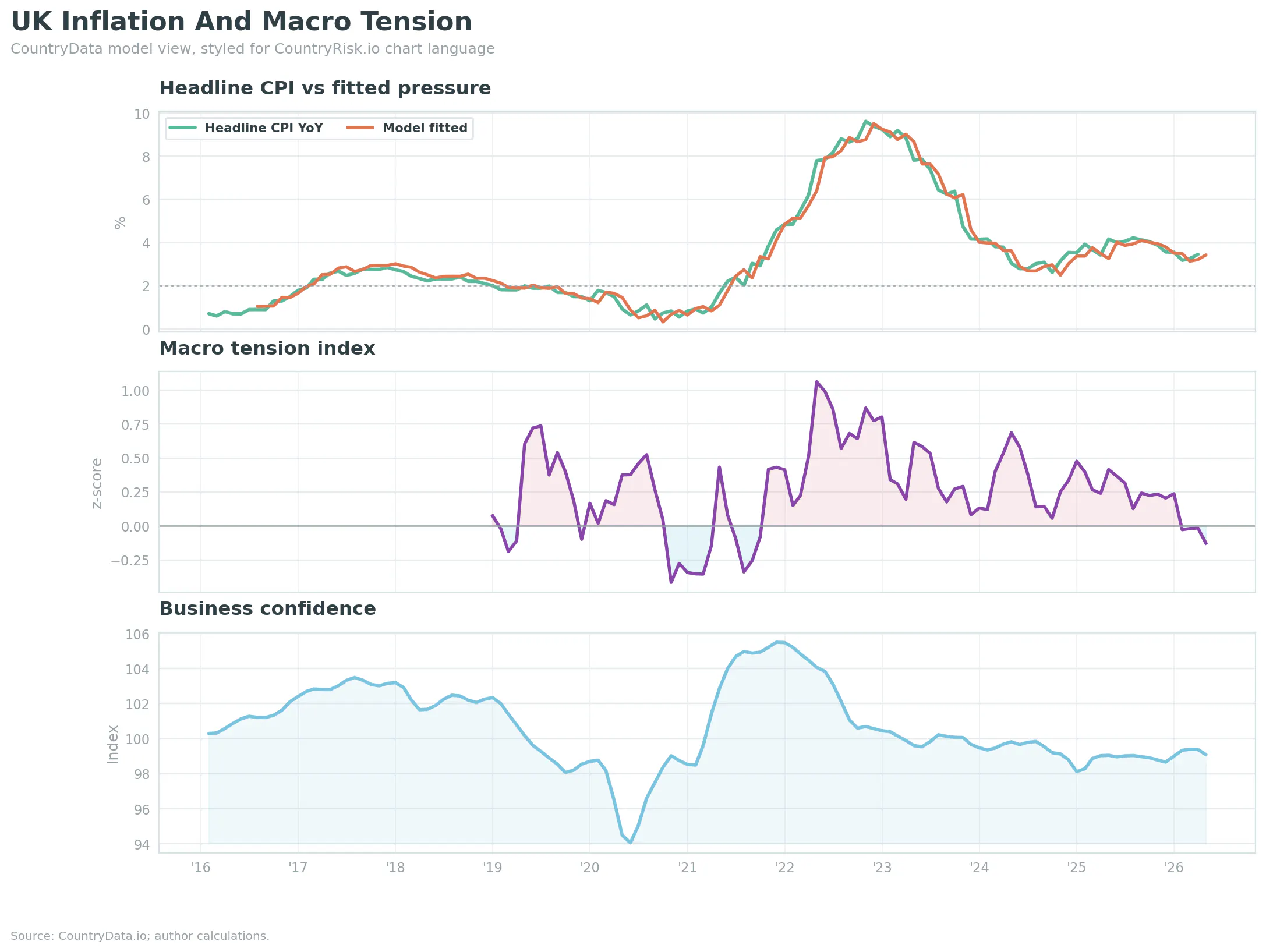
- A regression explaining headline inflation with lagged inflation, oil prices, unemployment, confidence, and rates.
- A macro tension index combining inflation pressure, inflation momentum, oil shocks, labour slack, confidence weakness, and policy tightness.
This is not meant to replace a full macroeconomic forecasting system. It is a fast, transparent framework for organizing evidence. The model helps answer whether the news is consistent with a benign expansion, an inflation scare, or a stagflationary mix.
The benefit of an agentic workflow is that the model can be rebuilt every time new data arrive. The chart pack, regression table, contribution analysis, and commentary can all update together.
Agents That Draft Notes
The final step is communication. Once the agent has gathered the news, queried the data, built the model, and generated charts, it can draft a short economist-style note.
The human economist should still edit it. That is important. Economic writing requires judgment about what matters, what is noise, and what the reader should do with the information. But the first draft no longer starts from a blank page. It starts from a structured evidence base.
For the UK case, the draft conclusion was that the situation is mixed rather than extreme. Inflation remains above target and fairly broad, rates are restrictive, unemployment has risen, and confidence is not clearly strong. Yet the macro tension index does not show an acute stagflation regime. That is a more useful conclusion than simply saying that GDP was better or inflation was high.
What The Human Economist Adds
The economist is not removed from the workflow. The economist becomes more valuable.
The human role is to:
- choose the research question
- decide whether the model structure is appropriate
- challenge weak assumptions
- interpret the result in policy and market context
- decide what should be published
- identify missing data that would improve the system
AI agents do the repetitive work. Economists do the judgment work.
The End State
The long-term vision is a research desk where agents continuously monitor the macro world and maintain a live set of country models. When something happens, the system can respond quickly:
- What changed in the news?
- Which data can verify or challenge the story?
- What does the model say?
- Which charts changed?
- What is the short economic interpretation?
- What data are missing?
This turns economic research into an adaptive operating system. The output is not just a report. It is a repeatable process that combines current news, structured data, empirical models, and expert judgment.
The hybrid economic research team is not about replacing economists. It is about giving economists leverage. Reach out to us if you are interested in super-charging your team.
Appendix
Here is the output of the entire workflow.
# UK Macro Commentary
The latest UK data tell a more nuanced story than the positive GDP headlines alone. The economy appears to have regained some near-term momentum, but the macro mix is not yet a clean expansion. Inflation remains above target, unemployment has moved higher, confidence is still soft, and short rates remain restrictive.
The model's March 2026 signal shows headline CPI inflation at 3.45% YoY, with 3-month annualized inflation at 2.60%. That is not an inflation crisis, but it is still uncomfortable for the Bank of England because the largest CPI contributions are not limited to one volatile category. Housing and utilities contributed around 1.36pp, transport 0.53pp, restaurants and hotels 0.44pp, recreation 0.33pp, and food 0.32pp. This points to a reasonably broad inflation base.
The macro tension index is close to neutral at -0.02, so the model does not yet classify the UK as being in an extreme stagflation regime. But the direction of risk is important. Inflation is above target even though oil prices are lower year-on-year, while unemployment is around 5.2% and business confidence remains below a clearly expansionary signal. That combination means the growth rebound is fragile: stronger GDP does not automatically translate into an easier policy trade-off.
The key insight beyond the news is that the Bank of England's problem is conditional. If the recent growth rebound is accompanied by firmer confidence and easing inflation breadth, policy can remain patient. If instead energy or regulated-price shocks lift inflation while unemployment and confidence worsen, the UK would move toward a more difficult stagflationary configuration.
For now, the model reads the UK as mixed rather than extreme: above-target inflation, restrictive rates, weaker labour-market momentum, but no decisive macro stress signal yet.