We wrote down how we think about sovereign risk — to prove a point
Everyone has the same AI — nobody has your method. We wrote ours down, position by position.

Bernhard Obenhuber
Oct 06, 2026
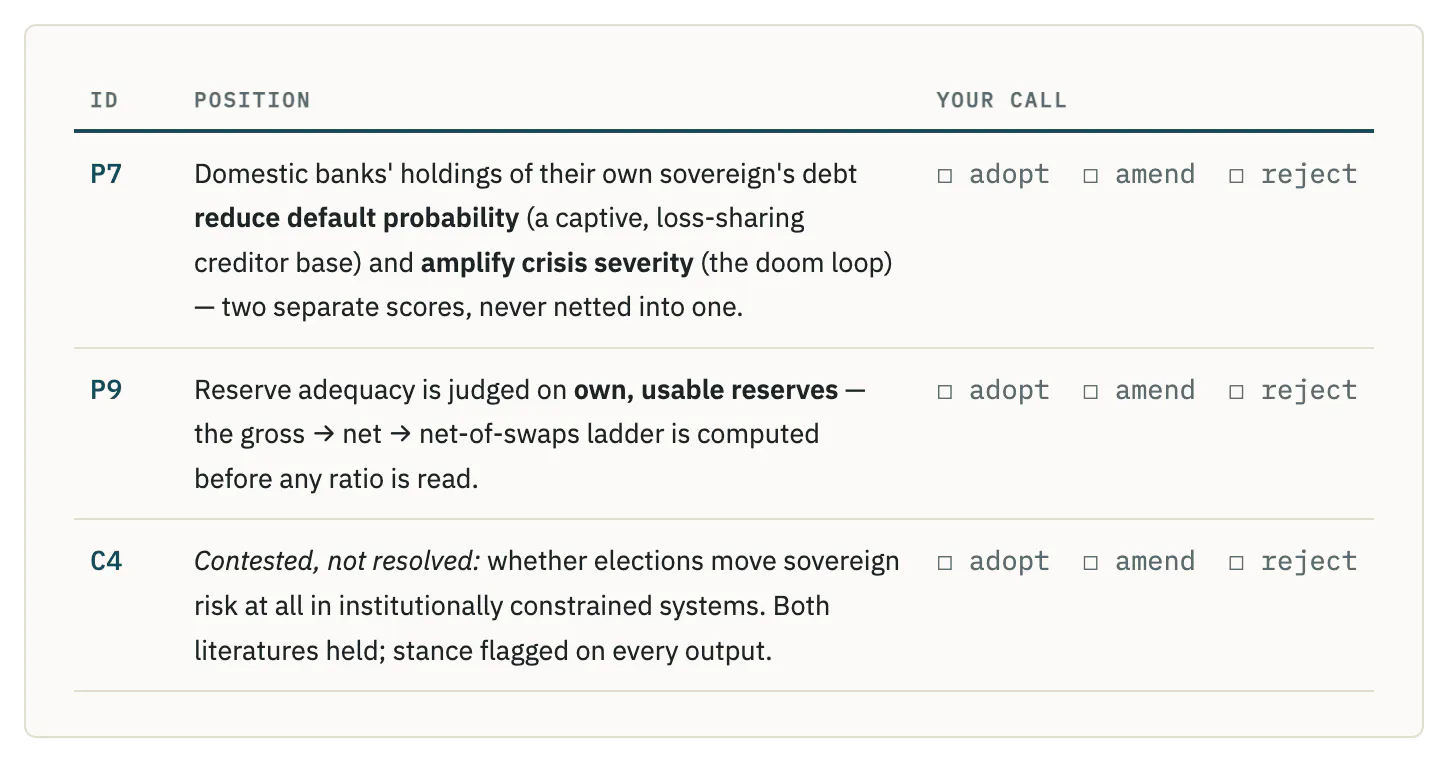
That table below is not a mock-up of a questionnaire. It is how our analytical method ships.
Every claim our system makes about a country — every grade, every scenario, every answer to a question typed into a chat box — now traces back to a numbered position like P7. Each position carries its evidence base. Each one can be adopted, amended, or rejected by the institution using it. When did your organisation last see its country-risk method written down at this resolution?
The problem: judgment as folklore
Country risk is a judgment discipline, and judgment has a storage problem. The method that produces a sovereign assessment — which indicators matter, which thresholds bite, when a rule of thumb stops applying — typically lives in the heads of a few senior analysts and in the connective tissue of documents nobody re-reads. When those analysts leave, the method leaves with them. When a committee asks why the house view is what it is, the answer is an appeal to experience, not an inspectable chain of reasoning.
Large language models were supposed to help. In practice they have made the governance problem sharper: ask a frontier model a sovereign-risk question and you get fluent, confident, method-free prose. It may be right. You cannot tell. There is no stated position behind it, no declared threshold, no record of what the model chose not to consider. For a regulated institution, an answer without an auditable method is not analysis — it is liability with good grammar.
The fix is not a better prompt. The fix is the unfashionable thing: write the method down, completely, and make both the humans and the machines run on it.
What we built
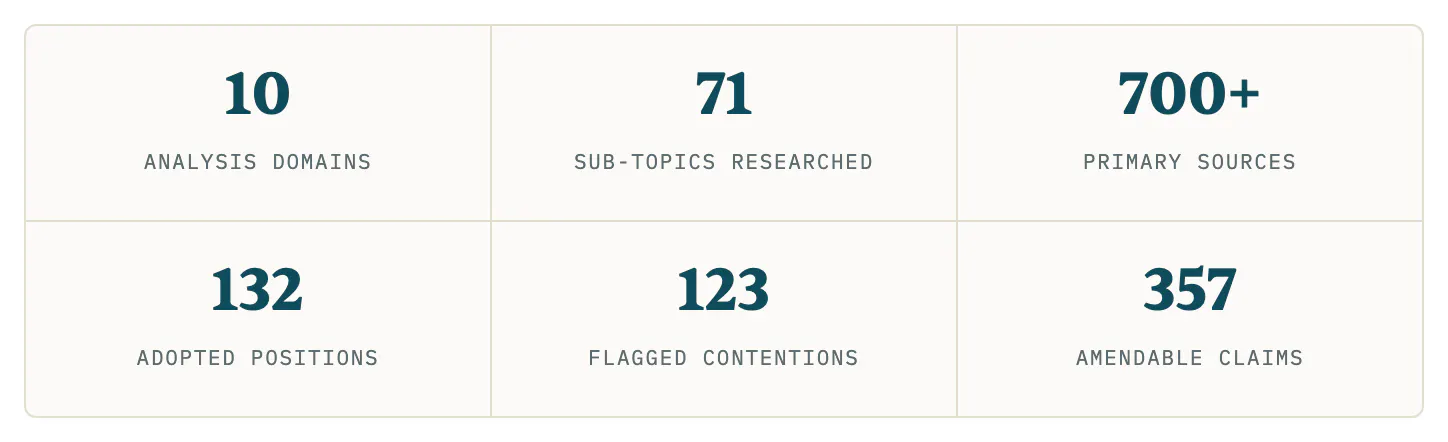
We call it the analysis doctrine: ten domain skills covering the full anatomy of a sovereign assessment — macro-fiscal, monetary & inflation, external sector, growth & competitiveness, banking, political economy, institutions & state capacity, structural resilience, crisis & event analysis, and comparative & quantitative methods.
Each domain was built the same way. We swept the literature sub-topic by sub-topic — 71 sweeps in all, from reserve-adequacy metrics to restructuring arithmetic to the political economy of default — collecting and reading the primary sources: IMF and BIS research, the academic canon, rating-agency criteria, post-mortems of the episodes that broke the previous consensus. Out of each sweep came a disciplined separation that most research processes skip:
What the evidence has settled became an adopted position — numbered, cited, stated in one falsifiable sentence. What remains genuinely contested became a flagged contention — held with both sides on record, never silently resolved. The distinction matters more than any individual answer: a method that cannot say “the literature disagrees here, and so we flag rather than conclude” will eventually present a coin-flip as a finding.
Two further disciplines run through all ten skills. Every judgment lands on an anchored scale — defined grades with stated conditions, not adjectives. And every method step declares which type of country it applies to: the reserve-adequacy machinery that is life-or-death for a pegged frontier market is formally switched off for a euro-area member, where the question migrates to a different place in the doctrine.
One knowledge state, two renderings
The doctrine would be shelf-ware if it existed only as documents. It doesn’t. Each skill is a single source of truth that renders two ways:
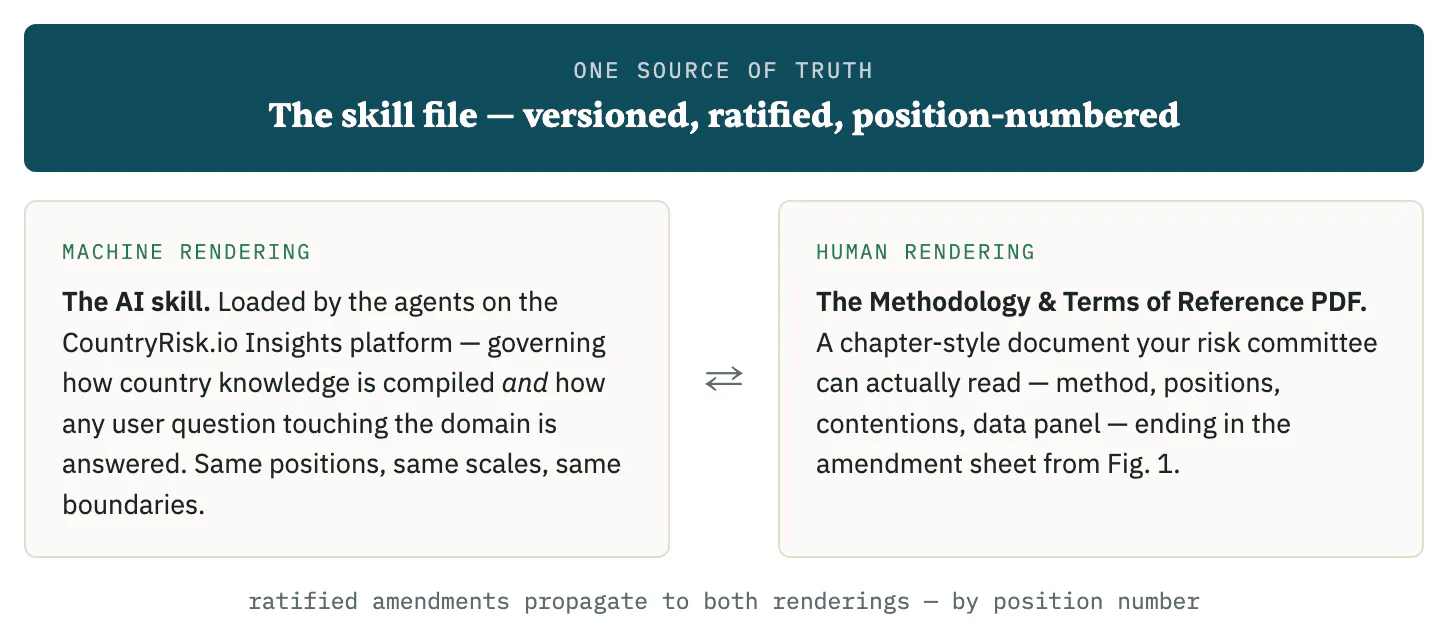
This is the part that changes the AI-governance conversation. When an analyst on our platform asks, “Can Egypt cover its external financing needs next year?”, the answer is not whatever the model happens to generate. It is reasoned through the external-sector skill: the financing-need arithmetic from its method section, the composition-beats-headline position, the anchored vulnerability bands — and it inherits every amendment your institution has ratified. The AI becomes an executor of a method you have read, marked up, and signed off. Disagreement stops being a feeling and becomes a changeset.
Where it sits: the knowledge system
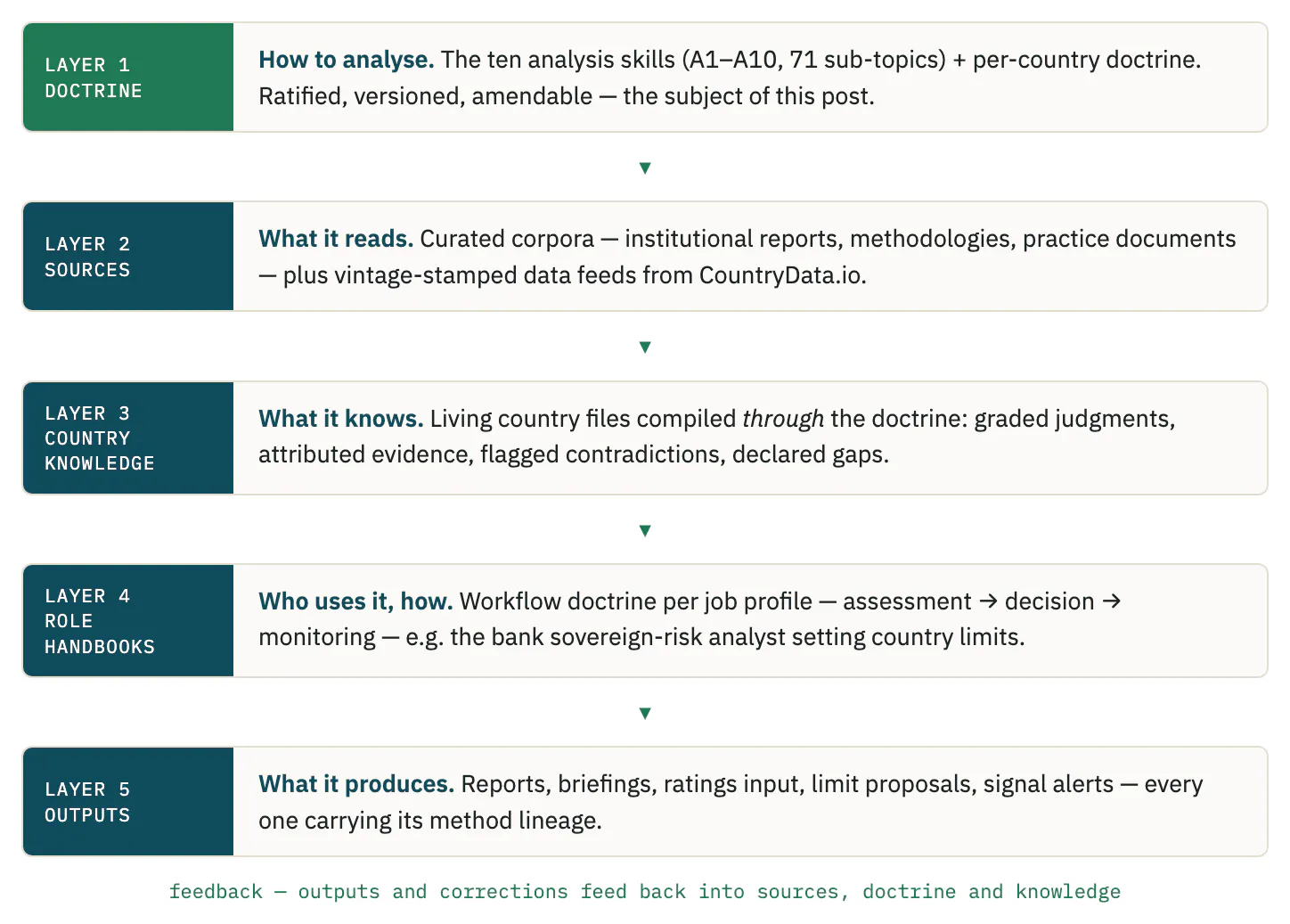
Data deserves one sentence of its own: every indicator named in a skill’s data panel is verified against CountryData.io — code, source, frequency, revision behaviour — and every figure the system cites carries a vintage stamp. Where a doctrine calls for data the platform doesn’t yet carry, the skill says so out loud rather than substituting something that merely looks similar. Method, data, and models share one governance spine.
The proof: we made Austria take the exam
A method you haven’t run on a real country is a brochure. So we recompiled our Austria country file — every page — through the new doctrine, and added a ninth page the doctrine demanded that the old file didn’t have.
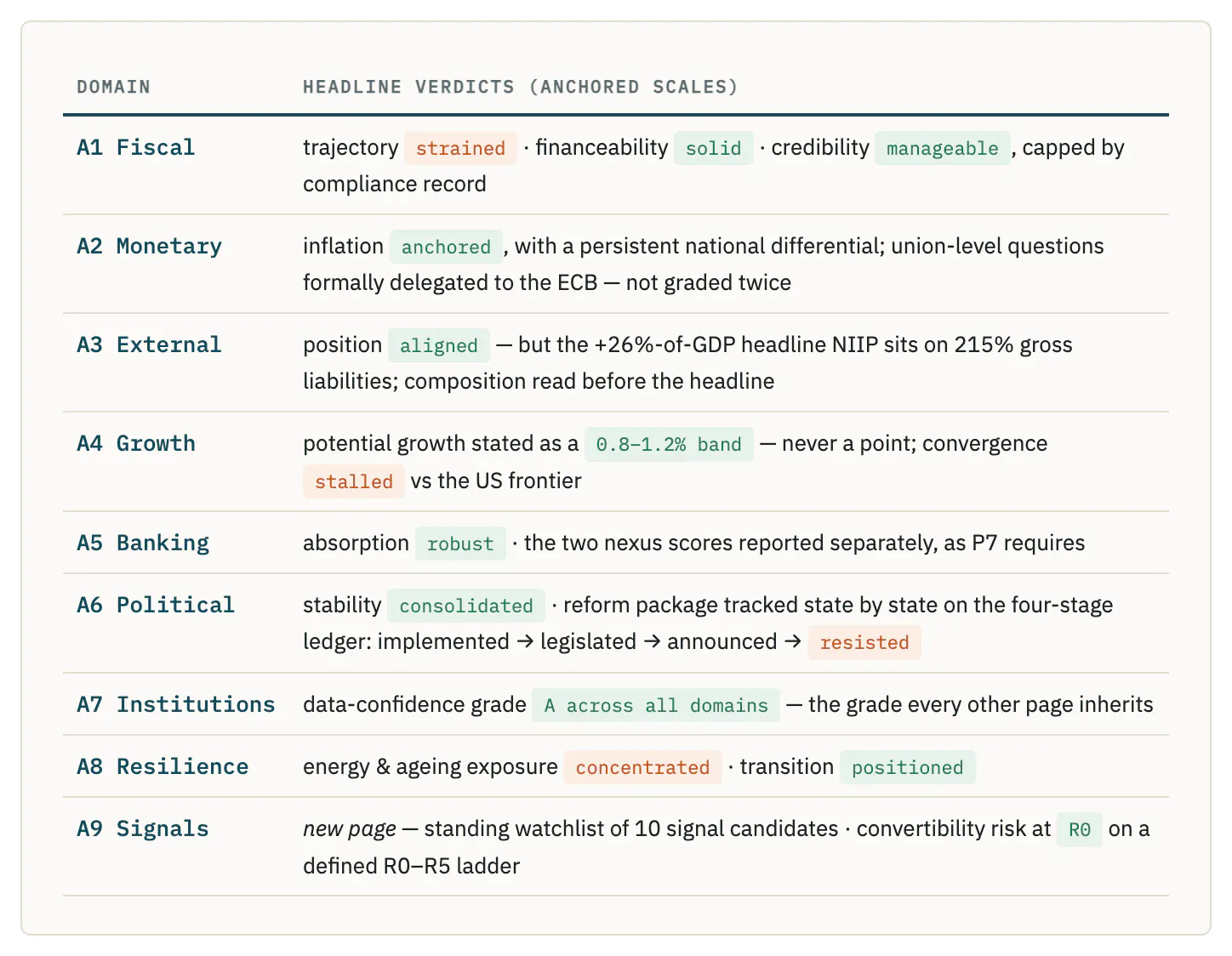
The grades are useful. What happened next is the reason to trust the system.
The doctrine’s first act on a real country was to produce a list of what it could not see.
Because every skill carries a coverage checklist, the recompile generated — alongside the judgments — an explicit gap register: the analysis a complete assessment requires that the current evidence base cannot yet support. For Austria, among other things:
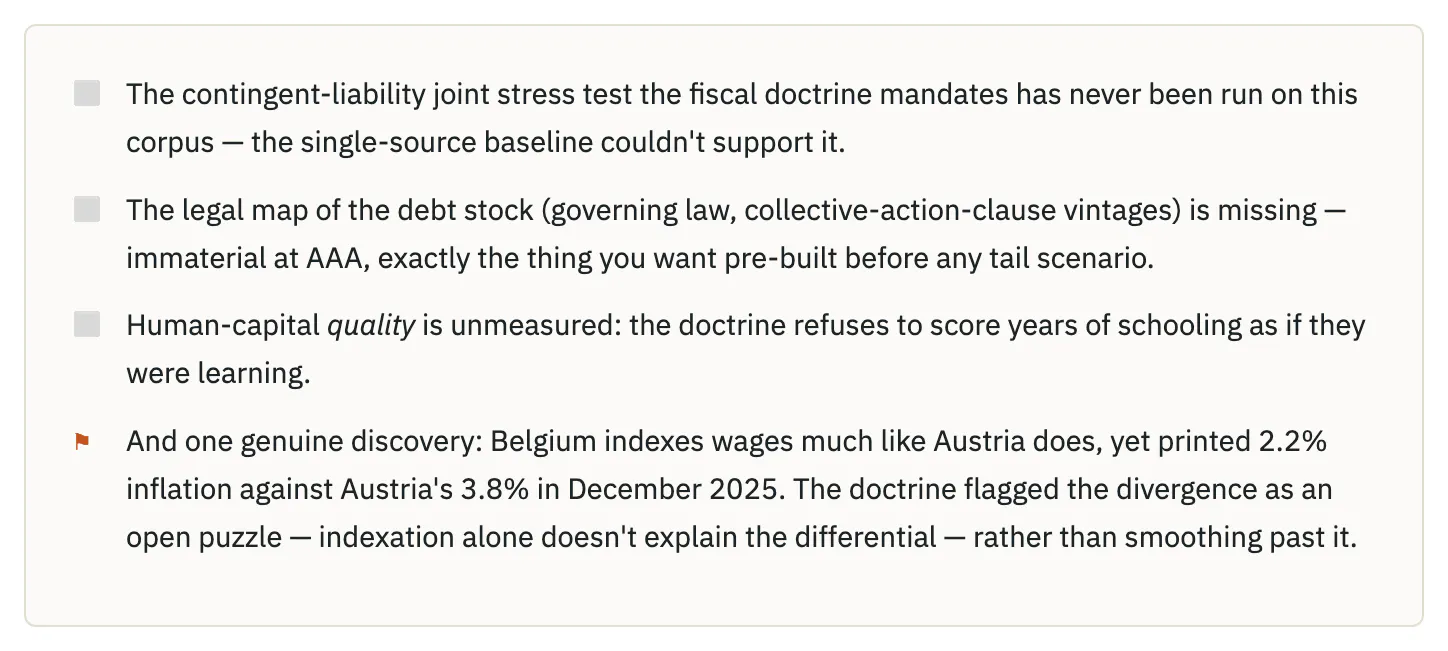
This is the property we think matters most, and the one that is hardest to retrofit: honesty as an architectural feature. The doctrine separates what is evidenced from what is assumed, grades the data it stands on, flags contradictions instead of averaging them, and declares its own blind spots. An AI system with those habits can be governed. One without them can only be believed.
Your doctrine is your edge
Nothing in this architecture is specific to sovereign credit. The same pattern — sub-topic research sweeps, positions separated from contentions, anchored scales, an amendment sheet, one knowledge state rendered for humans and machines alike — applies wherever institutions make recurring judgments under uncertainty: geopolitical and political-risk analysis, transition and climate exposure, supply-chain and counterparty risk, any discipline where the method currently lives in senior heads and leaves with them.
And we think it is where the competitive line is about to be drawn. Large language models are a commodity: everyone has access to the same frontier systems, trained on broadly the same public corpus. Run them bare and they converge on the same fluent consensus view — which is precisely the view that was priced in before you asked. What the models cannot commoditise is the layer on top: a house method that states where it departs from consensus and why, maintained, calibrated and sharpened with every cycle. The differentiating asset is no longer access to intelligence. It is the quality of the doctrine you make that intelligence run on.
Read the method. Mark it up.
Doctrine only earns the name when it survives contact with other practitioners. The amendment sheet is not an afterthought to the methodology documents — it is the point of them. Institutions that adopt the system don’t inherit our judgment; they ratify their own variant of it, position by position, and their AI runs on that.
Start with the macro-fiscal methodology. We are sharing the first Methodology & Terms of Reference document in the series — Macro-Fiscal Analysis (A1): the method, the positions we take, what remains contested, the data panel, and the amendment sheet. Read it the way a reviewer would. Then tell us where you’d amend it.
Write to [email protected] and we will send you the document — and, if you like, walk through the amendment sheet together.